12-hour clock to 24-hour clock
Morning (a.m.)
12:18 a.m.00 18
9:14 a.m.09 14
11:32 a.m.11 32
Afternoon / evening (p.m.)
12:10 p.m.12 10
2:22 p.m.14 22
6:55 p.m.18 55
11:05 p.m.23 05
For p.m. times from 1 p.m. to 11:59 p.m., add 12 to the hour.
Master 24-hour time, add and subtract time confidently, read timetables, convert between ordinary and decimal time, and solve time-zone problems with clear step-by-step methods.
Subtopic 1
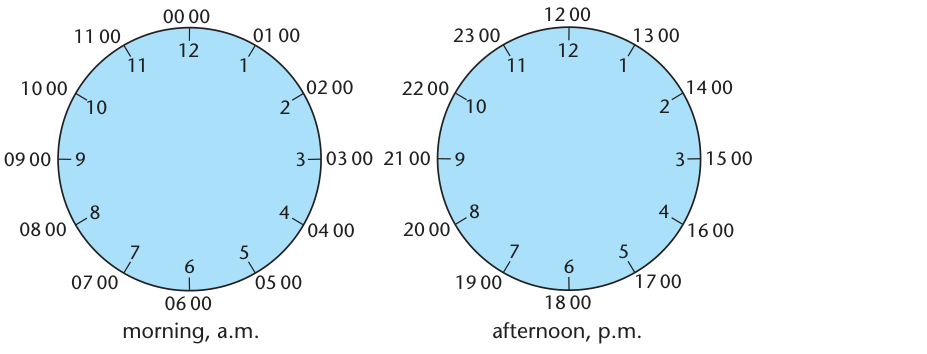
Times of day can be written using a.m., p.m., or the 24-hour clock. Morning times keep the same hour number, while afternoon times usually add 12 to the hour number.
For p.m. times from 1 p.m. to 11:59 p.m., add 12 to the hour.
Times between midnight and 1 a.m. start with 00.
Write 6.45 p.m. using the 24-hour clock.
Because it is a p.m. time, add 12 to the hour:
\[6+12=18\]So the time is \(\boxed{18\ 45}\).
Write \(21\ 17\) using a.m./p.m. notation.
21 is after 12, so subtract 12.
\[21-12=9\]So \(21\ 17\) is \(\boxed{9.17\text{ p.m.}}\).
Write 12.08 a.m. and 12.08 p.m. using the 24-hour clock.
12.08 a.m. is just after midnight, so it is \(\boxed{00\ 08}\).
12.08 p.m. is just after midday, so it is \(\boxed{12\ 08}\).
Do not write 12.30 p.m. as 24 30. Noon stays in the 12th hour: 12 30.
Write 24-hour times using four digits: 00:00 is midnight and 12:00 is noon. For p.m. times except 12 p.m., add 12 to the hour; for a.m. times except 12 a.m., keep the hour.
A bus leaves at 11:45 p.m. and reaches a stop at 12:20 a.m. Write these times in 24-hour notation.
11:45 p.m. is \(23{:}45\); 12:20 a.m. is \(00{:}20\) on the next day. Answer: \(\boxed{23{:}45\text{ and }00{:}20}\).
Try each question before opening the solution. Exam-style questions are original and modelled on the skills tested in examinations.
Write 7:05 a.m. in 24-hour notation.
Before 10 a.m., add a leading zero: 07:05.
Write 9:40 p.m. in 24-hour notation.
Add 12 to 9: 21:40. Answer: 21:40.
Write 00:18 in 12-hour notation.
The hour 00 is midnight: 12:18 a.m.
A timetable shows a bus leaving at 14:05. Write the time on a 12-hour clock.
14−12=2, so the time is 2:05 p.m.
Subtopic 2
When adding or subtracting time, remember that 60 minutes = 1 hour and 60 seconds = 1 minute. In harder questions, it helps to draw a timeline or break the journey into parts.
Split 40 minutes into 15 minutes to the next hour, then 25 more minutes.
Move to the next full hour first, then continue.
Mavis leaves for school at 7.45 a.m. and arrives 40 minutes later. At what time does she arrive?
From 7.45 a.m. to 8.00 a.m. is 15 minutes.
There are \(40-15=25\) minutes left.
So the arrival time is \(\boxed{8.25\text{ a.m.}}\).
A digital recorder starts at \(15\ 20\) and stops at \(17\ 10\). For how long does it record?
From \(15\ 20\) to \(16\ 00\) is 40 minutes.
From \(16\ 00\) to \(17\ 10\) is 1 hour 10 minutes.
Total time = \(1\text{ h }50\text{ min}\).
Answer: \(\boxed{1\text{ hour }50\text{ minutes}}\).
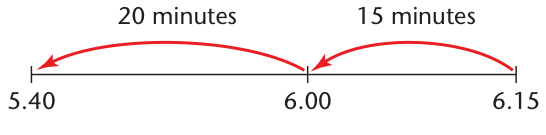
Nathee is ready to start cooking at 6.15 p.m. It took 35 minutes to prepare the food. At what time did he start preparing it?
15 minutes before 6.15 p.m. is 6.00 p.m.
There are \(35-15=20\) minutes still to go back.
20 minutes before 6.00 p.m. is \(\boxed{5.40\text{ p.m.}}\).
A coach leaves at \(23\ 35\) and arrives 2 hours 40 minutes later. Find the arrival time.
From \(23\ 35\) to \(24\ 00\) is 25 minutes.
That leaves 2 hours 15 minutes.
2 hours after midnight is \(02\ 00\), then 15 minutes more gives \(\boxed{02\ 15}\).
To subtract times, calculate total minutes or use a number-line working across whole hours. For a timetable, compare the displayed departure and arrival times and check whether arrival is on the next day.
A coach leaves at 22:35 and arrives at 01:15 next day. How long is the journey?
22:35→24:00 is 1 h 25 min. 00:00→01:15 is 1 h 15 min. Total \(\boxed{2\text{ h }40\text{ min}}\).
Try each question before opening the solution. Exam-style questions are original and modelled on the skills tested in examinations.
A train leaves at 08:20 and arrives at 10:05. Find the journey time.
08:20→09:00 = 40 min; 09:00→10:05 = 65 min. Total 105 min = 1 h 45 min.
Add 2 hours 35 minutes to 13:50.
13:50 + 2 h = 15:50; +35 min = 16:25.
A ferry takes 1 h 55 min and must arrive by 18:10. Find its departure time.
18:10 − 1 h = 17:10; −55 min = 16:15.
A flight leaves at 23:48 and lands at 03:12 on the next day. Find the time in the air.
23:48→24:00 = 12 min. 00:00→03:12 = 3 h 12 min. Total 3 h 24 min.
Subtopic 4
In speed and calculator questions, time is often written as a decimal number of hours. To work accurately, you must be able to convert both ways.
To convert minutes to hours, divide by 60.
To convert decimal hours to minutes, multiply the decimal part by 60.
Write 8 minutes 36 seconds in minutes.
36 seconds = \(\frac{36}{60}=0.6\) minutes.
So 8 minutes 36 seconds = \(8+0.6=\boxed{8.6\text{ minutes}}\).
Write 6.4 hours in hours and minutes.
The decimal part is 0.4 hours.
\[0.4\times60=24\text{ minutes}\]So the time is \(\boxed{6\text{ hours }24\text{ minutes}}\).
Write 15.36 hours in hours and minutes, correct to the nearest minute.
21.6 minutes rounds to 22 minutes.
So the answer is \(\boxed{15\text{ h }22\text{ min}}\).
The Beijing to Shanghai train travels 1318 km in 5 hours 37 minutes. Find the average speed, correct to the nearest km/h.
Convert time to hours:
\[37\div60=0.6166\ldots\text{ h}\]\[5\text{ h }37\text{ min}=5.6166\ldots\text{ h}\]Now use speed = distance ÷ time:
\[\text{speed}=\frac{1318}{5.6166\ldots}=234.658\ldots\]To the nearest km/h, \(\boxed{235\text{ km/h}}\).
To change minutes to a decimal of an hour, divide by 60. To change the decimal part of an hour to minutes, multiply by 60. Never treat “1 h 45 min” as “1.45 h”.
A train travels 135 km in 1 hour 48 minutes. Find its average speed in km/h.
\(1\text{ h }48\text{ min}=1+48/60=1.8\text{ h}\). Speed \(=135/1.8=\boxed{75\text{ km/h}}\).
Try each question before opening the solution. Exam-style questions are original and modelled on the skills tested in examinations.
Convert 42 min to hours, as a decimal.
\(42\div60=\boxed{0.7\text{ h}}\).
Write 2.25 h in hours and minutes.
\(0.25\times60=15\). Answer \(\boxed{2\text{ h }15\text{ min}}\).
Convert 1 hour 18 minutes to decimal hours.
\(1+18/60=\boxed{1.3\text{ h}}\).
A swimmer takes 0.625 hours. Express the time in minutes and seconds.
\(0.625\times60=37.5\) min. So \(\boxed{37\text{ min }30\text{ s}}\).
Subtopic 5
Different countries can have different local times. If one city is ahead, add hours to the other city’s time. If it is behind, subtract hours. In flight questions, first find the landing time in the departure city’s local time, then adjust to the destination’s local time.
“Ahead” means add hours. “Behind” means subtract hours.
The local time in Sydney is 6 hours ahead of the local time in Islamabad. What time is it in Sydney when it is \(11\ 00\) in Islamabad?
Sydney is ahead, so add 6 hours.
\[11\ 00+6\text{ h}=\boxed{17\ 00}\]An aircraft leaves Dubai at \(08\ 55\) local time and flies to Tokyo. The flight takes 9 hours 25 minutes. Local time in Tokyo is 5 hours ahead of Dubai. What is the local time in Tokyo when the aircraft lands?
First find the arrival time in Dubai time:
\(08\ 55+9\text{ h }25\text{ min}=18\ 20\).
Tokyo is 5 hours ahead, so add 5 hours:
\(18\ 20+5\text{ h}=\boxed{23\ 20}\).
An aircraft leaves Dubai at 01 50 local time and arrives in Sydney at 22 30 local time. The flight time is 13 hours 40 minutes. How many hours ahead of Dubai time is Sydney time?
Arrival time in Dubai time would be:
\(01\ 50+13\text{ h }40\text{ min}=15\ 30\).
Actual arrival local time in Sydney is \(22\ 30\).
The difference is \(22\ 30-15\ 30=\boxed{7\text{ hours}}\).
Use the difference between local times. Travelling east generally moves clocks ahead; west moves them back. In these questions, use the time-zone information supplied rather than assuming current real-world offsets.
City B is 4 hours ahead of City A. A flight leaves A at 19:10 and lasts 6 h 40 min. Find its arrival time in City B.
A-time arrival \(19{:}10+6{:}40=01{:}50\) next day. Add 4 hours: \(\boxed{05{:}50\text{ next day in B}}\).
Try each question before opening the solution. Exam-style questions are original and modelled on the skills tested in examinations.
City Q is 3 hours ahead of City P. If it is 10:00 in P, find time in Q.
Add 3 hours: 13:00 in Q.
City A is 5 hours behind City B. If time in B is 02:00 on Tuesday, find time in A.
Subtract 5 hours: 21:00 Monday.
A meeting starts at 16:30 in a city 2 hours ahead of Kuwait. Find its Kuwait time.
Subtract 2 hours: 14:30 Kuwait time.
An aircraft departs a city at 22:15, flies for 3 h 30 min and lands in a city 6 hours behind the departure city. State the arrival time and day.
Departure-zone arrival = 01:45 next day. Move clocks back 6 hours: 19:45 on the departure day at destination.
Start with clock-format conversions, then build to timeline, timetable and time-zone questions. Keep answers hidden until you have attempted each question.
Write these times using the 24-hour clock: a) 9.35 a.m. b) 2.08 p.m. c) 12.49 a.m.
a) \(\boxed{09\ 35}\)
b) Add 12, so \(\boxed{14\ 08}\)
c) Just after midnight, so \(\boxed{00\ 49}\)
Write these times using a.m./p.m. notation: a) \(03\ 45\) b) \(14\ 56\) c) \(23\ 40\).
a) \(\boxed{3.45\text{ a.m.}}\)
b) \(14-12=2\), so \(\boxed{2.56\text{ p.m.}}\)
c) \(23-12=11\), so \(\boxed{11.40\text{ p.m.}}\)
A train leaves at 14 40 and arrives 50 minutes later. What time does it arrive?
20 minutes takes us to 15 00, then 30 more minutes gives \(\boxed{15\ 30}\).
A film ends at 8.50 p.m. and lasted 1 hour 45 minutes. What time did it start?
8.50 p.m. − 50 minutes = 8.00 p.m. There are still 55 minutes to subtract.
8.00 p.m. − 55 minutes = \(\boxed{7.05\text{ p.m.}}\).
A ferry left Liverpool at 14 20 and arrived at Belfast at 21 05. How long did it take?
14 20 to 15 00 = 40 min; 15 00 to 21 00 = 6 h; 21 00 to 21 05 = 5 min.
Total = \(\boxed{6\text{ h }45\text{ min}}\).
Kylie leaves home at 7.50 a.m. and takes 2 hours 45 minutes to reach her friend’s house. What time does she arrive?
7.50 a.m. + 10 min = 8.00 a.m.; 2 h 35 min remain.
8.00 a.m. + 2 h 35 min = \(\boxed{10.35\text{ a.m.}}\).
Joe sets his digital recorder to switch on at 8.35 p.m. and switch off at 10.20 p.m. How long is the recorder on?
8.35 p.m. to 9.00 p.m. = 25 min; 9.00 p.m. to 10.00 p.m. = 1 h; 10.00 p.m. to 10.20 p.m. = 20 min.
Total = \(\boxed{1\text{ h }45\text{ min}}\).
A ferry leaves port at 08 35 on a 55-minute journey. It arrives 20 minutes late due to bad weather. What time does it arrive?
Scheduled arrival: \(08\ 35+55\text{ min}=09\ 30\).
20 minutes late means \(09\ 30+20\text{ min}=\boxed{09\ 50}\).
Write 3.26 hours in hours and minutes, correct to the nearest minute.
15.6 min rounds to 16 min, so the answer is \(\boxed{3\text{ h }16\text{ min}}\).
Write 4 hours 15 minutes as a decimal number of hours.
So the answer is \(\boxed{4.25\text{ h}}\).
Write 4.7 minutes in minutes and seconds.
The 0.7 minute part must be converted to seconds.
\[0.7\times60=42\text{ s}\]So the answer is \(\boxed{4\text{ min }42\text{ s}}\).
Soraya drives for 3 hours 17 minutes and travels 140 km. What is her average speed?
Convert the time to hours:
\[17\div60=0.2833\ldots\text{ h}\]\[3\text{ h }17\text{ min}=3.2833\ldots\text{ h}\]\[\text{speed}=\frac{140}{3.2833\ldots}=42.64\ldots\]So the average speed is about \(\boxed{42.6\text{ km/h}}\) or \(\boxed{43\text{ km/h}}\) to the nearest km/h.
A train travels at an average speed of 85 km/h. The journey distance is 495 km. The train leaves at 13 35. What time does it arrive? Give your answer to the nearest minute.
First find the time:
\[\text{time}=\frac{495}{85}=5.823529\ldots\text{ h}\]Convert the decimal part:
\[0.823529\ldots\times60=49.41\ldots\text{ min}\]So the journey takes about 5 h 49 min.
13 35 + 5 h 49 min = \(\boxed{19\ 24}\).
An aircraft leaves Karachi at 11 35 local time to fly to London. The flight time is 8 hours 30 minutes. The time in London is 4 hours behind the time in Karachi. What is the local time in London when the aircraft arrives?
Arrival time in Karachi time:
\(11\ 35+8\text{ h }30\text{ min}=20\ 05\).
London is 4 hours behind, so subtract 4 hours:
\(20\ 05-4\text{ h}=\boxed{16\ 05}\) or \(\boxed{4.05\text{ p.m.}}\).
An aircraft leaves Dubai at 01 50 local time and arrives in Sydney at 22 30 local time. The flight time is 13 hours 40 minutes. How many hours ahead of Dubai time is Sydney time?
01 50 + 13 h 40 min = 15 30 in Dubai time.
But the local arrival time in Sydney is 22 30.
The difference is \(22\ 30-15\ 30=\boxed{7\text{ hours}}\).
The local time in Dubai is 5 hours behind the local time in Tokyo. What time is it in Dubai when it is 21 00 in Tokyo? If a flight leaves Tokyo at 21 00 and lands 6 hours 20 minutes later, what is the landing time in Dubai local time?
Dubai is 5 hours behind Tokyo, so when it is 21 00 in Tokyo, it is \(\boxed{16\ 00}\) in Dubai.
The flight lands 6 h 20 min after 21 00 Tokyo time, so the arrival time in Tokyo time is \(03\ 20\) next day.
Dubai is still 5 hours behind, so subtract 5 hours: \(03\ 20-5\text{ h}=22\ 20\) on the previous day.
Landing time in Dubai local time: \(\boxed{22\ 20}\).
I can move confidently between 12-hour and 24-hour time, including midnight and noon.
I remember that 1 hour = 60 minutes and 1 minute = 60 seconds when adding or subtracting time.
I can break a time calculation into jumps to the next hour or to the next day.
I can find durations and arrival times from a timetable, even when the journey passes midnight.
I can convert ordinary time to decimal hours and back when solving speed questions.
I first find the arrival time in the departure city’s local time, then adjust for the time-zone difference.