Worked example 1 · Easy
Worked method
Simplify \(7p-3p+2p\).
\((7-3+2)p=\boxed{6p}\).
Simplifying, expanding, factorising and completing the square. Original explanations and examination-focused practice based on the supplied textbook's topic sequence.
Subtopic 1
Only like terms can be added or subtracted: they have the same variables raised to the same powers. Coefficients are the numbers multiplying the variables.
When multiplying terms, multiply coefficients and add powers of the same letter. Do not confuse \(3x^2\) and \(3x\), or \(x+x=2x\) with \(x\times x=x^2\).
Simplify \(7p-3p+2p\).
\((7-3+2)p=\boxed{6p}\).
Simplify \(4x+3y-7x+5y\).
\((4x-7x)+(3y+5y)=\boxed{-3x+8y}\).
Simplify \((-3a^2b)(4ab^3)\).
\((-3)(4)a^{2+1}b^{1+3}=\boxed{-12a^3b^4}\).
Identify what is given, write the correct rule, show the substitution or algebraic steps, and check the final result before moving on.
Subtopic 2
With several types of term, group them by their letter combinations and indices. \(xy\) and \(yx\) are like terms, but \(x^2y\) and \(xy^2\) are not.
Watch signs before brackets and around negative terms. Multiplication and division of numerical coefficients and index laws still apply.
Simplify \(3xy+5yx-2xy\).
Because \(xy=yx\), \((3+5-2)xy=\boxed{6xy}\).
Simplify \(2x^2y-5xy^2+7xy^2-x^2y\).
\((2-1)x^2y+(-5+7)xy^2=\boxed{x^2y+2xy^2}\).
Identify what is given, write the correct rule, show the substitution or algebraic steps, and check the final result before moving on.
Subtopic 3
To expand one bracket, multiply every term inside it by the factor outside. For a negative factor, each product changes sign accordingly.
Expansion and factorisation are reverse operations. Check an expansion by substituting an easy number or by reverse-factorising it.
Expand \(4(3x+2)\).
\(4(3x)+4(2)=\boxed{12x+8}\).
Expand and simplify \(-3x(2x^2-4x+5)\).
\(-6x^3+12x^2-15x\). Thus \(\boxed{-6x^3+12x^2-15x}\).
Identify what is given, write the correct rule, show the substitution or algebraic steps, and check the final result before moving on.
Subtopic 4
To factorise, find the highest common factor of all terms, including numbers and letters, and place it outside a bracket.
Divide each term by the factor to form the expression inside the bracket. Factorise fully and always multiply back out to check.
Factorise \(8x+12\).
The highest common factor is 4. \(\boxed{4(2x+3)}\).
Factorise \(15a^3b-10a^2b^2+5ab\).
Take out \(5ab\): \(\boxed{5ab(3a^2-2ab+1)}\).
Identify what is given, write the correct rule, show the substitution or algebraic steps, and check the final result before moving on.
Subtopic 5
Grouping is useful when four terms have no common factor all at once. Collect two pairs that each have a factor, then factorise the repeated bracket.
You may need to rearrange the terms or factor out a negative number. Your aim is to make the same bracket appear twice.
Factorise \(ax+bx+3ay+3by\).
\(x(a+b)+3y(a+b)=\boxed{(a+b)(x+3y)}\).
Factorise \(6xp-9x+4yp-6y\).
\(3x(2p-3)+2y(2p-3)=\boxed{(2p-3)(3x+2y)}\).
Identify what is given, write the correct rule, show the substitution or algebraic steps, and check the final result before moving on.
Subtopic 6
When multiplying two brackets, each term in the first bracket multiplies each term in the second. An area model, grid or distributive method can help you avoid missing products.
After multiplying, collect like terms. Negative signs matter: \((-3)(-4)=+12\). You can check by substitution.
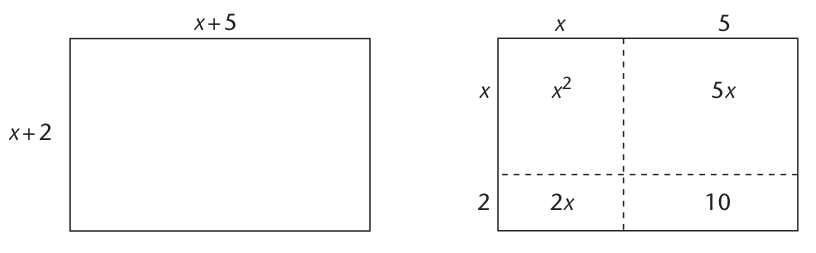
Expand \((x+3)(x+4)\).
\(x^2+4x+3x+12=\boxed{x^2+7x+12}\).
Expand \((2x-5)(x+7)\).
\(2x^2+14x-5x-35=\boxed{2x^2+9x-35}\).
Identify what is given, write the correct rule, show the substitution or algebraic steps, and check the final result before moving on.
Subtopic 7
The method is unchanged for algebraic coefficients or three brackets: multiply two brackets first, simplify, then multiply by the remaining bracket.
Keep intermediate working clearly arranged. Square brackets represent the same operation as ordinary brackets: multiply everything inside.
Expand \((3x+2y)(2x-y)\).
\(6x^2-3xy+4xy-2y^2=\boxed{6x^2+xy-2y^2}\).
Expand \((x+1)(x+2)(x-3)\).
First \((x+1)(x+2)=x^2+3x+2\). Then multiply by \(x-3\): \(x^3+3x^2+2x-3x^2-9x-6=\boxed{x^3-7x-6}\).
Identify what is given, write the correct rule, show the substitution or algebraic steps, and check the final result before moving on.
Subtopic 8
A difference of two squares occurs when one square term is subtracted from another. It factorises into two conjugate brackets.
If every term has a common factor, take it out first. Then factorise the remaining difference of squares.
Factorise \(x^2-49\).
\(49=7^2\), so \(\boxed{(x-7)(x+7)}\).
Fully factorise \(3x^2-75y^2\).
Take out 3: \(3(x^2-25y^2)=\boxed{3(x-5y)(x+5y)}\).
Identify what is given, write the correct rule, show the substitution or algebraic steps, and check the final result before moving on.
Subtopic 9
For a monic quadratic \(x^2+bx+c\), find two numbers with sum \(b\) and product \(c\). Place them into \((x+m)(x+n)\).
If \(c>0\), the signs match; if \(c<0\), the signs differ. Expand to verify both the middle and constant terms.
Factorise \(x^2+9x+20\).
Find 4 and 5: product 20, sum 9. \(\boxed{(x+4)(x+5)}\).
Factorise \(x^2-3x-28\).
Find -7 and +4: product -28, sum -3. \(\boxed{(x-7)(x+4)}\).
Identify what is given, write the correct rule, show the substitution or algebraic steps, and check the final result before moving on.
Subtopic 10
A perfect-square trinomial has first and last terms that are squares and a middle term that is twice the product of their square roots.
The sign of the middle term tells you which bracket sign to use. When in doubt, expand your proposed answer to verify it.
Factorise \(x^2+10x+25\).
\(25=5^2\) and \(10x=2(x)(5)\). Thus \(\boxed{(x+5)^2}\).
Factorise \(16a^2-24ab+9b^2\).
\((4a)^2-2(4a)(3b)+(3b)^2=\boxed{(4a-3b)^2}\).
Identify what is given, write the correct rule, show the substitution or algebraic steps, and check the final result before moving on.
Subtopic 11
For \(ax^2+bx+c\) with \(a\ne1\), seek two binomials whose leading coefficients multiply to \(a\), constant terms multiply to \(c\), and cross-products add to \(b\).
Always first take out any common factor. A reliable alternative is the split-middle-term method: find two numbers that multiply to \(ac\) and add to \(b\), split the middle term, then factorise by grouping.
Factorise \(2x^2+7x+3\).
\(ac=6\); numbers 6 and 1 add to 7. \(2x^2+6x+x+3=2x(x+3)+(x+3)=\boxed{(2x+1)(x+3)}\).
Fully factorise \(6x^2-15x+6\).
Take out 3: \(3(2x^2-5x+2)\). Split: \(2x^2-4x-x+2=(2x-1)(x-2)\). Answer \(\boxed{3(2x-1)(x-2)}\).
Identify what is given, write the correct rule, show the substitution or algebraic steps, and check the final result before moving on.
Subtopic 12
Expressions of the form \(ax^3+bx^2+cx\) have at least one factor \(x\). First remove the highest common numerical factor and \(x\), then factorise the remaining quadratic if possible.
A full factorisation is a product of factors; stop only when no polynomial factor can be factorised further using the methods you know.
Factorise \(x^3+5x^2+6x\).
\(x(x^2+5x+6)=\boxed{x(x+2)(x+3)}\).
Fully factorise \(6x^3+3x^2-30x\).
\(3x(2x^2+x-10)=\boxed{3x(2x+5)(x-2)}\).
Identify what is given, write the correct rule, show the substitution or algebraic steps, and check the final result before moving on.
Subtopic 13
Completing the square rewrites a quadratic as a square plus or minus a constant. For \(x^2+bx+c\), take half the \(x\)-coefficient for the bracket, then adjust the constant.
For \(ax^2+bx+c\), first factor \(a\) from the two \(x\)-terms. Completing the square helps find turning points, minimum or maximum values and solve quadratic equations later in the course.
A positive squared term is always at least zero; this makes the minimum of \((x-h)^2+k\) equal to \(k\). A negative squared term has a maximum instead.
Complete the square for \(x^2+8x+5\).
Half of 8 is 4. \(x^2+8x+5=(x+4)^2-16+5=\boxed{(x+4)^2-11}\).
Express \(2x^2-12x+13\) as \(a(x-h)^2+k\), and state its minimum value.
\(2(x^2-6x)+13=2[(x-3)^2-9]+13=\boxed{2(x-3)^2-5}\). Minimum is \(\boxed{-5}\), at \(x=3\).
Identify what is given, write the correct rule, show the substitution or algebraic steps, and check the final result before moving on.
These are newly written practice questions, not past-paper reproductions. Questions progress from confidence-building to exam-style. Answers are hidden until you open each question’s Show Answer section.
Simplify \(6x+4x\).
Step-by-step solution: \(\boxed{10x}\).
Simplify \(5a+7b-2a-3b\).
Step-by-step solution: \(5a-2a+7b-3b=\boxed{3a+4b}\).
Simplify \(2x\times5x^2\).
Step-by-step solution: \(2\times5\times x^{1+2}=\boxed{10x^3}\).
Simplify \(6m^2n-2mn^2+3mn^2-5m^2n\).
Step-by-step solution: \((6-5)m^2n+(-2+3)mn^2=\boxed{m^2n+mn^2}\).
Simplify \(4ab+3ba\).
Step-by-step solution: \(ab=ba\), hence \(\boxed{7ab}\).
Simplify \(8p^2-5p+3p^2+2p\).
Step-by-step solution: \(\boxed{11p^2-3p}\).
Simplify \(5x^2y+2xy^2-3x^2y\).
Step-by-step solution: \(\boxed{2x^2y+2xy^2}\).
Simplify \(-2ab^2+5a^2b+7ab^2-3a^2b\).
Step-by-step solution: \((-2+7)ab^2+(5-3)a^2b=\boxed{5ab^2+2a^2b}\).
Expand \(3(a+4)\).
Step-by-step solution: \(\boxed{3a+12}\).
Expand \(-2(5x-3)\).
Step-by-step solution: \(\boxed{-10x+6}\).
Expand \(4y(2y-5)\).
Step-by-step solution: \(\boxed{8y^2-20y}\).
Expand and simplify \(-2a(3a^2-4a-6)\).
Step-by-step solution: \(\boxed{-6a^3+8a^2+12a}\).
Factorise \(5x+20\).
Step-by-step solution: \(\boxed{5(x+4)}\).
Factorise \(12p^2-18p\).
Step-by-step solution: \(\boxed{6p(2p-3)}\).
Factorise \(9ab+6ac\).
Step-by-step solution: \(\boxed{3a(3b+2c)}\).
Fully factorise \(18x^3y-12x^2y^2\).
Step-by-step solution: Common factor \(6x^2y\): \(\boxed{6x^2y(3x-2y)}\).
Factorise \(ax+bx+ay+by\).
Step-by-step solution: \((a+b)(x+y)\).
Factorise \(2ax+2bx+ay+by\).
Step-by-step solution: \(2x(a+b)+y(a+b)=\boxed{(a+b)(2x+y)}\).
Factorise \(px-py+3x-3y\).
Step-by-step solution: \(p(x-y)+3(x-y)=\boxed{(p+3)(x-y)}\).
Factorise \(6ax-9bx+4ay-6by\).
Step-by-step solution: \(3x(2a-3b)+2y(2a-3b)=\boxed{(2a-3b)(3x+2y)}\).
Expand \((x+1)(x+2)\).
Step-by-step solution: \(x^2+2x+x+2=\boxed{x^2+3x+2}\).
Expand \((x-4)(x+3)\).
Step-by-step solution: \(x^2+3x-4x-12=\boxed{x^2-x-12}\).
Expand \((3x+2)(x-1)\).
Step-by-step solution: \(3x^2-3x+2x-2=\boxed{3x^2-x-2}\).
Expand and simplify \((2a-3b)(4a+b)\).
Step-by-step solution: \(8a^2+2ab-12ab-3b^2=\boxed{8a^2-10ab-3b^2}\).
Expand \((2x+1)(x+3)\).
Step-by-step solution: \(2x^2+6x+x+3=\boxed{2x^2+7x+3}\).
Expand \((2a-b)(a+3b)\).
Step-by-step solution: \(2a^2+6ab-ab-3b^2=\boxed{2a^2+5ab-3b^2}\).
Expand \((x+2)^2\) by multiplying two brackets.
Step-by-step solution: \((x+2)(x+2)=x^2+2x+2x+4=\boxed{x^2+4x+4}\).
Expand \((x-1)(x+1)(x+4)\).
Step-by-step solution: First \((x-1)(x+1)=x^2-1\). Then \((x^2-1)(x+4)=\boxed{x^3+4x^2-x-4}\).
Factorise \(x^2-16\).
Step-by-step solution: \(\boxed{(x-4)(x+4)}\).
Factorise \(9a^2-25\).
Step-by-step solution: \(\boxed{(3a-5)(3a+5)}\).
Factorise \(4x^2-49y^2\).
Step-by-step solution: \(\boxed{(2x-7y)(2x+7y)}\).
Fully factorise \(2x^2-98\).
Step-by-step solution: \(2(x^2-49)=\boxed{2(x-7)(x+7)}\).
Factorise \(x^2+5x+6\).
Step-by-step solution: 2 and 3 sum to 5 and multiply to 6. \(\boxed{(x+2)(x+3)}\).
Factorise \(x^2-9x+20\).
Step-by-step solution: -4 and -5: \(\boxed{(x-4)(x-5)}\).
Factorise \(x^2+2x-15\).
Step-by-step solution: 5 and -3: \(\boxed{(x+5)(x-3)}\).
Factorise \(y^2-11y-26\).
Step-by-step solution: -13 and 2 give sum -11, product -26. \(\boxed{(y-13)(y+2)}\).
Factorise \(x^2+6x+9\).
Step-by-step solution: \(\boxed{(x+3)^2}\).
Factorise \(y^2-14y+49\).
Step-by-step solution: \(\boxed{(y-7)^2}\).
Factorise \(4x^2+12x+9\).
Step-by-step solution: \(\boxed{(2x+3)^2}\).
Factorise \(25p^2-30pq+9q^2\).
Step-by-step solution: \(\boxed{(5p-3q)^2}\).
Factorise \(2x^2+5x+2\).
Step-by-step solution: \(\boxed{(2x+1)(x+2)}\).
Factorise \(3x^2+10x+3\).
Step-by-step solution: \(\boxed{(3x+1)(x+3)}\).
Factorise \(2x^2-x-6\).
Step-by-step solution: \(\boxed{(2x+3)(x-2)}\).
Fully factorise \(4x^2-14x+6\).
Step-by-step solution: Take out 2: \(2(2x^2-7x+3)\). Then \(\boxed{2(2x-1)(x-3)}\).
Factorise \(x^3+3x^2\).
Step-by-step solution: Common factor \(x^2\): \(\boxed{x^2(x+3)}\).
Factorise \(x^3-9x\).
Step-by-step solution: \(x(x^2-9)=\boxed{x(x-3)(x+3)}\).
Factorise \(2x^3+10x^2+12x\).
Step-by-step solution: \(2x(x^2+5x+6)=\boxed{2x(x+2)(x+3)}\).
Fully factorise \(3x^3-12x^2-15x\).
Step-by-step solution: \(3x(x^2-4x-5)=\boxed{3x(x-5)(x+1)}\).
Complete the square for \(x^2+4x+1\).
Step-by-step solution: \((x+2)^2-4+1=\boxed{(x+2)^2-3}\).
Complete the square for \(x^2-6x+7\).
Step-by-step solution: \((x-3)^2-9+7=\boxed{(x-3)^2-2}\).
Write \(x^2+10x+30\) in completed-square form.
Step-by-step solution: \((x+5)^2-25+30=\boxed{(x+5)^2+5}\).
Complete the square for \(3x^2+12x+7\) and state the minimum value.
Step-by-step solution: \(3(x^2+4x)+7=3[(x+2)^2-4]+7=\boxed{3(x+2)^2-5}\). Minimum \(\boxed{-5}\).