Worked example · Easy
Continue an additive pattern
\(7,12,17,22,\ldots\) Find the next two terms.
Each term increases by 5.
\(22+5=27,\qquad27+5=32\); next terms: 27, 32.
Recognise and explain number patterns, move between term-to-term and position-to-term rules, and find formulas for linear and non-linear sequences.
Subtopic 1
A sequence is an ordered list of numbers or shapes. A term-to-term rule explains how to obtain the next term from the one before it. Identify whether the pattern adds or subtracts a fixed number, multiplies or divides, or follows another rule.
The first few terms alone do not always uniquely determine a sequence, so state a rule that is consistent with the pattern. When moving backwards, reverse the operation: undo “add 4” by subtracting 4, for example.

\(7,12,17,22,\ldots\) Find the next two terms.
Each term increases by 5.
\(22+5=27,\qquad27+5=32\); next terms: 27, 32.
\(41,35,29,23,\ldots\) Find the previous term and the next term.
The rule is “subtract 6”. Going backwards, add 6: \(41+6=47\).
Going forwards, subtract 6: \(23-6=17\).
\(192,96,48,24,\ldots\). Find the eighth term.
Divide each term by 2.
\(T_5=12,\ T_6=6,\ T_7=3,\ T_8=1.5\).
Write down the appropriate rule, substitute carefully, show each rearrangement and check that the final result answers the question.
The questions progress from straightforward recall to multi-step exam-style reasoning. Answers are hidden until selected.
\(9,13,17,21,\ldots\) Write the next three terms.
\(d=4\). Hence \(25,29,33\).
\(50,43,36,29,\ldots\) Write the next two terms.
\(d=-7\); \(22,15\).
\(2,6,18,54,\ldots\) Find the next two terms.
\(r=3\); \(54\times3=162\), \(162\times3=486\).
\(625,125,25,5,\ldots\) Find the next term and the term immediately before 625.
\(r=\frac15\); next is \(1\) and previous is \(625\times5=3125\).
The numbers \(4,9,16,25,36\) form a pattern. Find the next two terms and describe it.
They are consecutive square numbers from \(2^2\) to \(6^2\).
Next: \(7^2=49\) and \(8^2=64\).
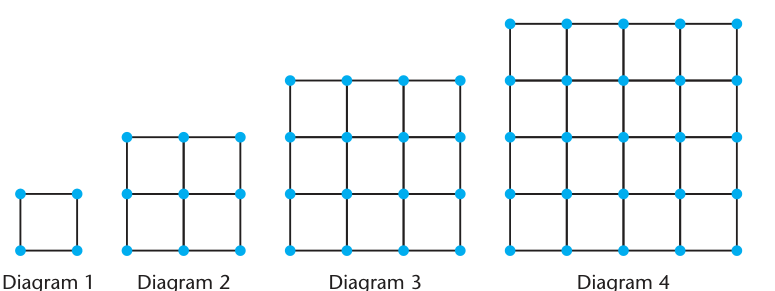
A grid pattern has \(1,4,9,16\) small squares. How many small squares occur in diagrams 5 and 10?
The figures are square arrays: diagram \(n\) has \(n^2\) squares.
Diagram 5: \(5^2=25\); diagram 10: \(10^2=100\).
A sequence starts at 3 and each subsequent term is 4 more than double the previous term. Find terms 2, 3 and 4.
\(T_{n+1}=2T_n+4\)
\(T_2=2(3)+4=10,\ T_3=2(10)+4=24,\ T_4=2(24)+4=52\)
Sequence A increases by 4 and starts at 7. Sequence B starts at 2 and triples each time. List the first five terms of each.
A: \(7,11,15,19,23\).
B: \(2,6,18,54,162\).
Subtopic 2
A linear sequence has the same difference between every pair of consecutive terms. Check the first differences, not just whether the numbers get larger. A sequence can be linear and decreasing.
If the first differences are not constant, the sequence is not linear. For instance, \(1,4,9,16\) has differences 3, 5 and 7, so it is not linear.
\(6,10,14,18\). Is this linear?
First differences: \(4,4,4\).
They are constant, so the sequence is linear.
Which is linear: \(9,6,3,0\) or \(2,6,18,54\)?
First pattern: differences \(-3,-3,-3\); linear.
Second pattern: differences \(4,12,36\); not linear.
\(28,\ \square,\ 14,\ 7\) is linear. Find the missing term and the common difference.
The change from 14 to 7 is \(-7\).
Go backwards: \(14+7=21\). Missing term \(21\).
Write down the appropriate rule, substitute carefully, show each rearrangement and check that the final result answers the question.
The questions progress from straightforward recall to multi-step exam-style reasoning. Answers are hidden until selected.
Is \(11,17,23,29,35\) linear? Give the common difference.
\(17-11=23-17=\cdots=6\); yes, linear, \(d=6\).
Is \(2,5,10,17,26\) linear? Explain.
Differences: \(3,5,7,9\). They are not constant, so not linear.
A linear sequence starts at \(-4\) and has common difference 7. Write five terms.
\(-4,3,10,17,24\).
In a linear sequence \(T_4=19\) and \(T_7=34\). Find the common difference.
There are 3 steps between term 4 and 7.
\(d=\frac{34-19}{7-4}=5\).
Find the missing number: \(30,\ \square,\ 18,\ 12\) (linear).
\(d=12-18=-6\); second term \(30-6=24\).
The sequence \(8,15,22,29,\ldots\) is linear. State how many is added each time and find term 8.
\(d=7\).
\(T_8=8+7(7)=57\).
A learner says the sequence \(4,7,10,14\) is linear. Is this correct?
Differences \(3,3,4\) are not constant. The learner is incorrect.
Two linear sequences have differences 3 and 5, and both start at 2. What are their fourth terms?
\(A_4=2+3\times3=11\)
\(B_4=2+3\times5=17\).
Subtopic 3
The nth term, usually written \(T_n\) or \(u_n\), is a formula for a term in position \(n\). Start with \(n=1\) for the first term. Substitute the position to find any requested term.
To decide whether a number belongs to the sequence, set the nth-term expression equal to that number and solve for \(n\). Its solution must be a positive whole number.
If \(T_n=4n-1\), find \(T_3\).
\(T_3=4(3)-1=11\).
For \(T_n=5n+2\), find term 60.
\(T_{60}=5(60)+2=302\).
Does 98 occur in the sequence with \(T_n=6n+2\)?
\(6n+2=98\Rightarrow6n=96\Rightarrow n=16\).
Since 16 is a positive integer, yes: 98 is term 16.
Write down the appropriate rule, substitute carefully, show each rearrangement and check that the final result answers the question.
The questions progress from straightforward recall to multi-step exam-style reasoning. Answers are hidden until selected.
If \(T_n=3n+4\), find \(T_1\) and \(T_5\).
\(T_1=3+4=7,\quad T_5=15+4=19\).
The nth term is \(7n-2\). Find term 20.
\(T_{20}=7(20)-2=138\).
For \(T_n=28-3n\), find terms 1, 2 and 3.
\(25,22,19\).
Is 64 in the sequence with nth term \(5n-1\)?
\(5n-1=64\Rightarrow n=13\); yes, term 13.
Is 50 in the sequence with nth term \(4n+3\)?
\(4n+3=50\Rightarrow n=\frac{47}{4}=11.75\).
Not a positive integer, so no.
If \(T_n=2n^2+1\), find \(T_6\).
\(T_6=2(36)+1=73\).
An nth-term formula is \(T_n=11-2n\). Find the first term which is negative.
\(11-2n<0\Rightarrow n>5.5\).
First positive whole number satisfying this is \(n=6\). \(T_6=-1\).
The nth term is \(4n+9\). Which term is 205?
\(4n+9=205\Rightarrow n=\frac{196}{4}=49\); term 49.
Subtopic 4
For a linear sequence, use \(T_n=an+b\). The coefficient \(a\) is the constant difference. Find \(b\) by substituting the first term: \(T_1=a+b\).
For example, a sequence with common difference 4 and first term 7 has \(a=4\) and \(b=7-4=3\), so \(T_n=4n+3\). For more complicated data, substitute two known term positions and solve the simultaneous equations.
\(5,9,13,17,\ldots\). Find \(T_n\).
Difference 4 and first term 5.
\(T_n=4n+(5-4)=\boxed{4n+1}\).
\(23,19,15,11,\ldots\). Find \(T_n\).
Difference \(-4\) and first term 23.
\(T_n=-4n+(23+4)=\boxed{27-4n}\).
A linear sequence has \(T_3=14\) and \(T_9=44\). Find \(T_n\).
\(6a=44-14=30\Rightarrow a=5\).
\(14=3(5)+b\Rightarrow b=-1\).
Hence \(T_n=\boxed{5n-1}\).
Write down the appropriate rule, substitute carefully, show each rearrangement and check that the final result answers the question.
The questions progress from straightforward recall to multi-step exam-style reasoning. Answers are hidden until selected.
Find the nth term of \(8,11,14,17,\ldots\).
\(d=3,\ b=8-3=5\). So \(T_n=3n+5\).
Find the nth term of \(18,13,8,3,\ldots\).
\(d=-5,\ b=18+5=23\). So \(T_n=23-5n\).
Find the nth term of \(-3,1,5,9,\ldots\).
\(d=4,\ b=-3-4=-7\). So \(T_n=4n-7\).
Find \(T_n\) if \(T_1=6\) and \(d=\frac12\).
\(T_n=6+\frac12(n-1)=\frac{n+11}{2}\).
A linear sequence has \(T_2=11\) and \(T_6=31\). Find the formula.
\(4d=31-11=20\Rightarrow d=5\).
\(11=2(5)+b\Rightarrow b=1\); \(T_n=5n+1\).
A sequence has \(T_n=7n-3\). Write the first four terms and the common difference.
\(4,11,18,25\); \(d=7\).
Two linear sequences both start at 5, but one has difference 2 and the other difference 5. Find both nth-term formulas.
\(A_n=5+2(n-1)=2n+3\)
\(B_n=5+5(n-1)=5n\).
Find the nth term if \(T_5=2\) and \(T_{12}=-19\).
\(d=\frac{-19-2}{12-5}=-3\).
\(2=-3(5)+b\Rightarrow b=17\); \(T_n=17-3n\).
Subtopic 5
A quadratic sequence has constant second differences. Its nth term can be written \(an^2+bn+c\), with \(2a\) equal to the constant second difference. Substitute \(n=1,2,3\) to find any remaining coefficients.
For cubic sequences, inspect third differences and compare with \(n^3\). For exponential sequences, check whether the ratio between consecutive terms is constant: their typical nth term is \(ar^{n-1}\). Do not confuse a quadratic difference pattern with a geometric ratio.
\(1,8,27,64,\ldots\). Find \(T_n\) and the fifth term.
These are cubes \(1^3,2^3,3^3,4^3\).
\(T_n=n^3,\quad T_5=125\).
\(3,8,15,24,35,\ldots\). Find \(T_n\).
First differences \(5,7,9,11\); second differences \(2,2,2\). Thus \(a=1\).
Subtract \(n^2\) from the terms: \(2,4,6,8,10\), which equals \(2n\).
\(T_n=\boxed{n^2+2n}\).
\(8,13,20,29,\ldots\). Find a formula and term 20.
Differences \(5,7,9\); second difference \(2\), hence \(a=1\).
Put \(T_n=n^2+bn+c\). From terms 1 and 2: \(b+c=7\) and \(2b+c=9\). Thus \(b=2,\ c=5\).
\(T_n=n^2+2n+5\); \(T_{20}=400+40+5=\boxed{445}\).
Write down the appropriate rule, substitute carefully, show each rearrangement and check that the final result answers the question.
The questions progress from straightforward recall to multi-step exam-style reasoning. Answers are hidden until selected.
Find the nth term of \(1,4,9,16,25,\ldots\).
\(T_n=n^2\).
Find the nth term of \(2,9,28,65,126,\ldots\).
\(1^3+1=2,\;2^3+1=9,\;3^3+1=28\). Thus \(T_n=n^3+1\).
The sequence is \(4,12,36,108,\ldots\). Find the nth term.
First term 4, ratio 3.
\(T_n=4\cdot3^{n-1}\).
Find the nth term of \(5,10,17,26,37,\ldots\).
Second difference is 2, so start with \(n^2\).
\(T_n-n^2=4,6,8,10,12=2n+2\). Thus \(T_n=n^2+2n+2\).
A quadratic sequence is \(6,11,18,27,\ldots\). Find its nth term.
Second difference 2, so \(a=1\).
\(b+c=5,\ 2b+c=7\Rightarrow b=2,c=3\). Thus \(T_n=n^2+2n+3\).
For \(T_n=3n^2-2n+1\), calculate term 12.
\(T_{12}=3(144)-24+1=409\).
A geometric sequence begins with 160 and halves each time. Find the sixth term and a formula.
\(T_n=160(\tfrac12)^{n-1}\).
\(T_6=160(\tfrac12)^5=5\).
A dot pattern contains \(n^2+2n+1\) dots at stage \(n\). How many dots are in stages 5 and 12?
\(n^2+2n+1=(n+1)^2\).
\(T_5=6^2=36,\quad T_{12}=13^2=169\).