Worked example · Easy
Convert centimetres to millimetres
Express 6.48 cm in mm.
There are 10 mm in 1 cm, so multiply by 10.
\[6.48\times10=\boxed{64.8\text{ mm}}\]Learn how to choose the right units, convert lengths, masses and capacities, and apply squared and cubed conversion factors to area and volume. Work from simple conversions to examination-style measurement problems.
Subtopic 1
Most measurements in this chapter use the metric system. A metric conversion changes how a quantity is written, not its actual size. Decide whether the answer should get numerically bigger or smaller before calculating.
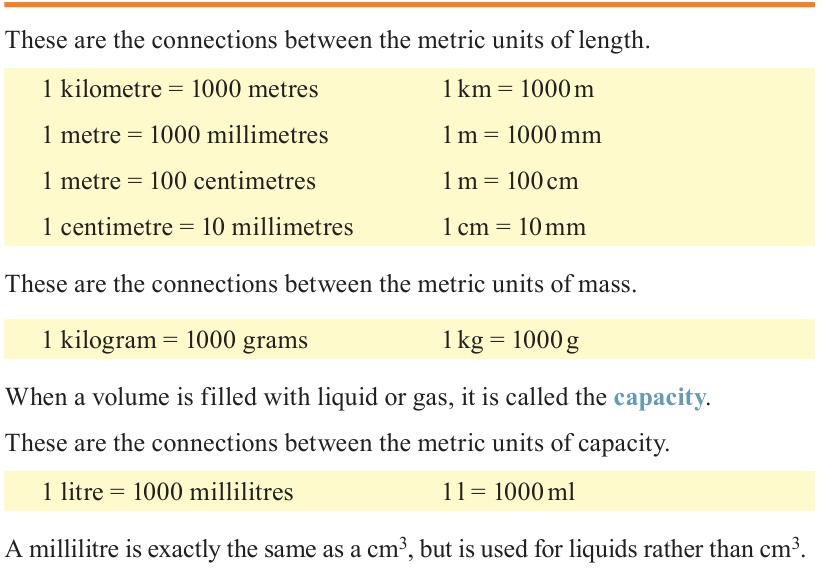
Use mm for very short lengths, cm for small objects, m for rooms and buildings, and km for long distances.
\[1\text{ km}=1000\text{ m},\qquad1\text{ m}=100\text{ cm}=1000\text{ mm},\qquad1\text{ cm}=10\text{ mm}\]Method: Multiply to change a larger unit into a smaller unit. Divide to change a smaller unit into a larger unit. If several lengths are added, first convert them all into the same unit.
Express 6.48 cm in mm.
There are 10 mm in 1 cm, so multiply by 10.
\[6.48\times10=\boxed{64.8\text{ mm}}\]Write 3575 mm in metres.
There are 1000 mm in 1 m; divide by 1000.
\[3575\div1000=\boxed{3.575\text{ m}}\]A journey covers 1.8 km, then 650 m, then another 2.35 km. Give the total in km.
Step 1: Convert the metres to kilometres.
\[650\text{ m}=0.65\text{ km}\]Step 2: Add.
\[1.8+0.65+2.35=\boxed{4.8\text{ km}}\]Arrange 0.42 m, 39 cm and 415 mm from shortest to longest.
Write all lengths in millimetres.
\[0.42\text{ m}=420\text{ mm};\quad39\text{ cm}=390\text{ mm}\]Since \(390<415<420\), the correct order is:
39 cm, 415 mm, 0.42 m.
If a problem includes whole kilograms, decimal kilograms and grams, converting everything to grams often makes the arithmetic easier. \(\tfrac12\) kg is 500 g and \(\tfrac14\) kg is 250 g.
Express 0.075 kg in grams.
A recipe uses 1.25 kg of flour, 375 g of sugar and \(\tfrac12\) kg of oats. Find the total mass in kg.
Convert to grams and add.
\[1250+375+500=2125\text{ g}\]\[2125\div1000=\boxed{2.125\text{ kg}}\]A café begins with 4 kg of rice. It uses 850 g at lunch and 1.35 kg at dinner. Find the mass left in grams.
Use one unit throughout.
\[4\text{ kg}=4000\text{ g};\quad1.35\text{ kg}=1350\text{ g}\]\[4000-850-1350=\boxed{1800\text{ g}}\]Capacity is how much liquid or gas a container can hold. Litres and millilitres are commonly used; centilitres also occur in the textbook exercises.
\[1\text{ litre}=1000\text{ ml},\qquad1\text{ cl}=10\text{ ml},\qquad100\text{ cl}=1\text{ litre}\]For measuring volume in cubic centimetres, the important link is \(1\text{ ml}=1\text{ cm}^3\). We develop this further in the next subtopic.
A jug holds 2.08 litres. Convert this capacity to ml.
Convert 37 cl to litres.
First change centilitres to millilitres, then to litres.
\[37\text{ cl}=370\text{ ml}=\boxed{0.37\text{ litres}}\]A container holds 5.2 litres of juice. Seven 450 ml bottles are filled. How many litres remain?
Step 1: Convert the starting capacity.
\[5.2\text{ litres}=5200\text{ ml}\]Step 2: Find the total poured out.
\[7\times450=3150\text{ ml}\]Step 3: Subtract and convert back.
\[5200-3150=2050\text{ ml}=\boxed{2.05\text{ litres}}\]Subtopic 2
The conversion factor changes when the measurement is squared or cubed. This follows from the number of dimensions:
If the length conversion is a factor of 10, the area factor is \(10^2=100\), and the volume factor is \(10^3=1000\).
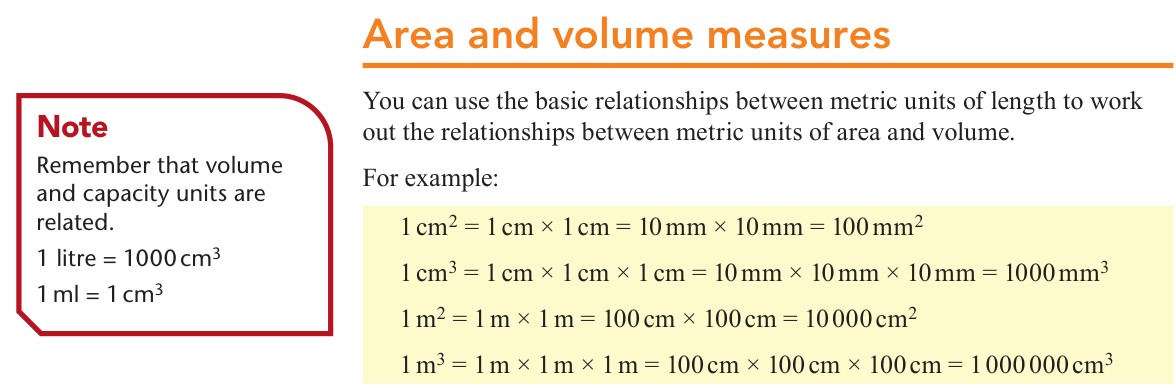
One square kilometre is 100 hectares. A hectare is a unit of area, not length.
Convert 3.7 m² to cm².
Write 8600 mm² in cm².
Because \(1\text{ cm}^2=100\text{ mm}^2\), divide by 100.
\[8600\div100=\boxed{86\text{ cm}^2}\]Convert 0.28 km² to hectares.
Use \(1\text{ km}^2=100\text{ hectares}\).
\[0.28\times100=\boxed{28\text{ hectares}}\]A rectangular carpet is 3.6 m long and 250 cm wide. Find its area in m².
Convert the width first: \(250\text{ cm}=2.5\text{ m}\).
\[A=3.6\times2.5=\boxed{9\text{ m}^2}\]A cuboid has \(V=\text{length}\times\text{width}\times\text{height}\). All three lengths must be expressed in the same unit before multiplying.
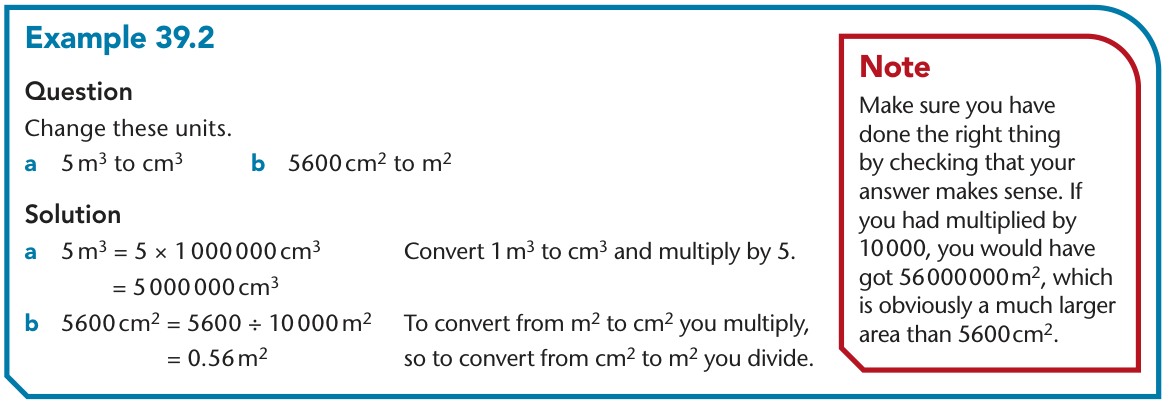
Convert 0.006 m³ to cm³.
Convert 24 500 mm³ to cm³.
One cm³ is 1000 mm³.
\[24\,500\div1000=\boxed{24.5\text{ cm}^3}\]A water container has a volume of 6750 cm³. Express its capacity in litres.
Since 1000 cm³ is 1 litre, divide by 1000.
\[6750\div1000=\boxed{6.75\text{ litres}}\]A cuboid water tank is 40 cm long and 25 cm wide. It holds 18 litres when full. Find its height.
Step 1: Convert capacity to cubic centimetres.
\[18\text{ litres}=18\,000\text{ cm}^3\]Step 2: Use cuboid volume and rearrange.
\[40\times25\times h=18\,000\]\[h=\frac{18\,000}{1000}=\boxed{18\text{ cm}}\]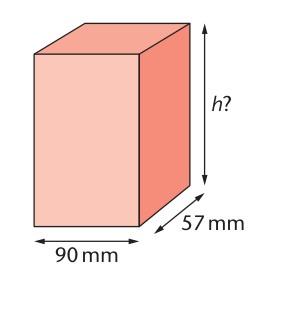
The textbook carton has a base 90 mm by 57 mm and holds 1 litre. Find the height to the nearest mm.
Step 1: \(1\text{ litre}=1000\text{ cm}^3=1\,000\,000\text{ mm}^3\).
\[V=lwh\implies h=\frac{1\,000\,000}{90\times57}\]\[h\approx194.932\text{ mm}\approx\boxed{195\text{ mm}}\]This is a measurement question based on the supplied textbook diagram.
Start with quick unit conversions, then attempt mixed-unit calculations and realistic multi-step problems. All exercises are newly written in examination style; they are not copied past-paper questions. Open Show Answer only when ready to check your steps.
Convert 8.34 cm to millimetres.
Multiply by 10 because 1 cm = 10 mm.
\[8.34\times10=\boxed{83.4\text{ mm}}\]Convert 0.675 m to cm.
Multiply by 100.
\[0.675\times100=\boxed{67.5\text{ cm}}\]Convert 7240 mm into metres.
Divide by 1000.
\[7240\div1000=\boxed{7.24\text{ m}}\]Convert 3.045 km into metres.
Convert 0.038 kg into grams.
Convert 4650 g into kilograms.
Write 63 cl in ml.
One centilitre holds 10 ml.
\[63\times10=\boxed{630\text{ ml}}\]Convert 815 ml to litres.
Convert 6.2 cm² into mm².
Square the length factor: \(10^2=100\).
\[6.2\times100=\boxed{620\text{ mm}^2}\]Convert 18 600 cm² into m².
Divide by 10 000.
\[18\,600\div10\,000=\boxed{1.86\text{ m}^2}\]Convert 4.25 cm³ to mm³.
Cube the factor 10: \(10^3=1000\).
\[4.25\times1000=\boxed{4250\text{ mm}^3}\]Convert 0.35 m³ into litres.
One cubic metre contains 1000 litres.
\[0.35\times1000=\boxed{350\text{ litres}}\]A path is 1.65 km long. Another section measures 890 m. Find the total in km.
Convert 890 m to 0.89 km, then add.
\[1.65+0.89=\boxed{2.54\text{ km}}\]Put 750 g, 0.82 kg, 0.705 kg and 95 g in order, lightest first.
Convert to grams: 750 g, 820 g, 705 g, 95 g.
95 g, 0.705 kg, 750 g, 0.82 kg.
A baker has 3.2 kg of flour and uses 875 g. How many grams remain?
Change 3.2 kg to 3200 g.
\[3200-875=\boxed{2325\text{ g}}\]A 2.4-litre jug is filled. A student pours out three 360 ml glasses. How much remains in litres?
Three glasses use \(3\times360=1080\) ml.
\[2400-1080=1320\text{ ml}=\boxed{1.32\text{ litres}}\]Convert 2.75 hectares into square metres.
One hectare is 10 000 m².
\[2.75\times10\,000=\boxed{27\,500\text{ m}^2}\]A park occupies 0.064 km². How many hectares is this?
One km² is 100 hectares.
\[0.064\times100=\boxed{6.4\text{ hectares}}\]Change 0.018 m³ into cm³.
Express 37 500 mm³ in cm³.
A container holds 9250 cm³ of water. Find its capacity in litres.
1 litre = 1000 cm³.
\[9250\div1000=\boxed{9.25\text{ litres}}\]Which is larger: 0.36 m² or 3400 cm²? By how many cm²?
Convert the first area.
\[0.36\times10\,000=3600\text{ cm}^2\]\[3600-3400=\boxed{200\text{ cm}^2}\]So 0.36 m² is larger.
A container has internal dimensions 30 cm by 20 cm by 15 cm. How many litres does it hold?
Find the volume, then divide by 1000.
\[30\times20\times15=9000\text{ cm}^3\]\[9000\div1000=\boxed{9\text{ litres}}\]A noticeboard measures 1.8 m by 85 cm. Find its area in m².
Convert 85 cm to 0.85 m.
\[A=1.8\times0.85=\boxed{1.53\text{ m}^2}\]A pupil cycles 4.25 km, jogs 780 m and walks 1250 m. Find the total distance in km.
Convert metres to kilometres: 780 m = 0.78 km; 1250 m = 1.25 km.
\[4.25+0.78+1.25=\boxed{6.28\text{ km}}\]A canteen begins with 5 kg of rice. Each of four trays needs 675 g. Find the remaining mass in kilograms.
Convert all masses to grams.
\[4\times675=2700\text{ g}\]\[5000-2700=2300\text{ g}=\boxed{2.3\text{ kg}}\]A barrel contains 8.6 litres of juice. It is poured into 250 ml bottles. How many completely filled bottles are possible and how much juice is left?
Convert litres to ml, then divide.
\[8.6\text{ litres}=8600\text{ ml};\qquad8600\div250=34\text{ remainder }100\]34 full bottles, with 100 ml left.
A rectangular foundation is 6 m long, 2.5 m wide and 40 cm deep. Find its volume in m³ and litres.
Convert depth first: 40 cm = 0.4 m.
\[V=6\times2.5\times0.4=6\text{ m}^3\]\[6\times1000=\boxed{6000\text{ litres}}\]The volume is 6 m³, or 6000 litres.
A cuboid tank has a base 80 cm by 50 cm and a capacity of 120 litres. Find its height in cm.
Convert 120 litres to 120 000 cm³.
\[80\times50\times h=120\,000\]\[h=\frac{120\,000}{4000}=\boxed{30\text{ cm}}\]A student says, “3 m² = 300 cm² because 1 m = 100 cm.” Explain the mistake and give the correct value.
Area is two-dimensional, so multiply by \(100^2\), not 100.
\[3\times100^2=3\times10\,000=\boxed{30\,000\text{ cm}^2}\]Using the length factor instead of its square caused the error.
A rectangular box has internal dimensions 12 cm by 9 cm by 7.5 cm. How many whole cubes of side 1.5 cm can fit in a regular grid, with edges parallel?
Divide each dimension by the cube side, then multiply the whole-number counts.
\[12\div1.5=8,\quad9\div1.5=6,\quad7.5\div1.5=5\]\[8\times6\times5=\boxed{240\text{ cubes}}\]Two identical rectangular sports pitches have a combined area of 1.5 hectares. Each is 125 m long. Find the width of each pitch.
Convert hectares and divide equally.
\[1.5\text{ ha}=15\,000\text{ m}^2\]\[\text{Area per pitch}=15\,000\div2=7500\text{ m}^2\]\[\text{Width}=7500\div125=\boxed{60\text{ m}}\]I use sensible mm, cm, m, km, g, kg, ml or litres and include units in answers.
I convert everything to the same unit before adding, subtracting or comparing.
I square length factors for area and cube them for volume.
I know 1 ml = 1 cm³, 1 litre = 1000 cm³ and 1 m³ = 1000 litres.
I use a cuboid's volume and distinguish whole items that physically fit from their theoretical volume.
I check whether the answer is larger or smaller when it should be, and give a suitable degree of accuracy.