Worked example · Easy
Move a point
Translate \(A(2,3)\) by \(\binom{4}{-2}\).
Add components: \(A\mapsto (2+4,3-2)=\boxed{(6,1)}\).
Clear explanations, original worked examples and a full graded exercise set, mapped to the textbook.
Describe vector translations; use vector notation, column operations, scalars, position vectors and magnitudes; explain geometric relationships with vector arguments.
Begin with the easy examples, then attempt the medium and exam-style examples before using the hidden solutions.
Subtopic 1
A vector specifies both a direction and a distance. A translation moves every point of a shape by the same vector without turning it, reflecting it or changing its size. A vector \(\binom{a}{b}\) means move \(a\) units horizontally and \(b\) vertically; left and down movements are negative.
\((x,y)\xrightarrow{\binom{a}{b}}(x+a,y+b)\). A vector from \(A(x_1,y_1)\) to \(B(x_2,y_2)\) is \(\binom{x_2-x_1}{y_2-y_1}\).
Exam tip: Check the sign of each movement. Translation affects every vertex in the same way.
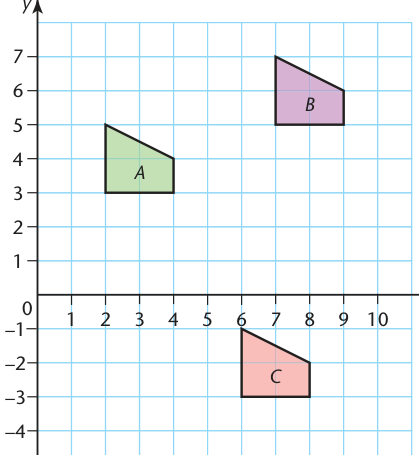
Every solution explains the mathematical method and gives the result.
Translate \(A(2,3)\) by \(\binom{4}{-2}\).
Add components: \(A\mapsto (2+4,3-2)=\boxed{(6,1)}\).
Find the vector taking \(P(-2,5)\) to \(Q(4,1)\).
Horizontal \(=4-(-2)=6\). Vertical \(=1-5=-4\). Vector \(=\boxed{\binom6{-4}}\).
Triangle \(ABC\) has vertices \(A(1,-1),B(3,2),C(-2,4)\). Translate it by \(\binom{-3}{5}\).
Add \((-3,5)\) to each point: \(A\mapsto\boxed{(-2,4)},\ B\mapsto\boxed{(0,7)},\ C\mapsto\boxed{(-5,9)}\).
Subtopic 2
Vector arrows indicate direction. \(\overrightarrow{AB}\) is the displacement from point \(A\) to point \(B\), while \(\overrightarrow{BA}\) is its negative. Different arrows represent the same vector when they have equal magnitude and direction, regardless of where they start.
Bold lower-case letters such as \(\mathbf a\) name vectors, while a plain number is a scalar.
\(\overrightarrow{BA}=-\overrightarrow{AB}\); \(\overrightarrow{AA}=\mathbf0\). Equal vectors have matching components, not merely equal length.
Exam tip: Do not mistake the vector from A to B for the coordinates of B.
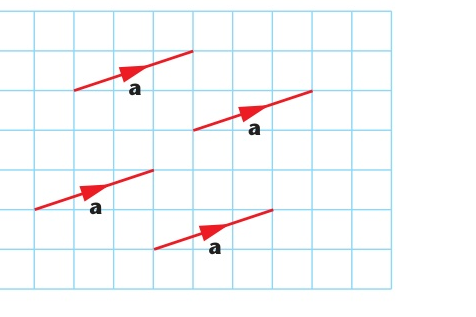
Every solution explains the mathematical method and gives the result.
If \(\overrightarrow{AB}=\binom{-3}{5}\), find \(\overrightarrow{BA}\).
Reverse the vector: \(\overrightarrow{BA}=-\binom{-3}{5}=\boxed{\binom3{-5}}\).
\(\mathbf a=\binom{2}{-4}\) and \(\mathbf b=\binom{2}{-4}\) have different starting points. Are they equal?
Yes. Their horizontal and vertical components match, so \(\boxed{\mathbf a=\mathbf b}\).
If \(\overrightarrow{PQ}=\mathbf p\) and \(\overrightarrow{QR}=\mathbf q\), express \(\overrightarrow{RP}\).
Along \(P\to Q\to R\), \(\overrightarrow{PR}=\mathbf p+\mathbf q\). Reverse it: \(\boxed{\overrightarrow{RP}=-\mathbf p-\mathbf q}\).
Subtopic 3
Multiplying by a positive scalar changes the length of a vector while preserving direction. A negative scalar reverses its direction. A scalar of \(0\) produces the zero vector. Parallel vectors are scalar multiples of one another.
\(k\binom ab=\binom{ka}{kb}\). Magnitudes scale by \(|k|\).
Exam tip: Scale both components. A factor of −2 doubles the length and reverses direction.
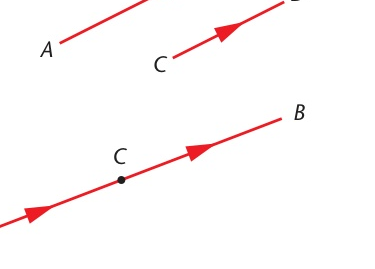
Every solution explains the mathematical method and gives the result.
Find \(2\binom{-1}{3}\).
\(2\binom{-1}{3}=\boxed{\binom{-2}{6}}\).
Find \(-3\binom{2}{-4}\).
\(\binom{-6}{12}\). Both components change sign and triple in size: \(\boxed{\binom{-6}{12}}\).
Are \(\binom6{-9}\) and \(\binom{-2}{3}\) parallel?
\(\binom6{-9}=-3\binom{-2}{3}\), so \(\boxed{\text{yes, they are parallel}}\).
Subtopic 4
Adding successive movements gives the resultant displacement. Add the corresponding components. To subtract a vector, add its opposite. Draw arrows head-to-tail if a visual check is useful.
\(\binom ab+\binom cd=\binom{a+c}{b+d}\); \(\binom ab-\binom cd=\binom{a-c}{b-d}\).
Exam tip: Subtract every component in the stated order. Vector addition is commutative; subtraction is not.
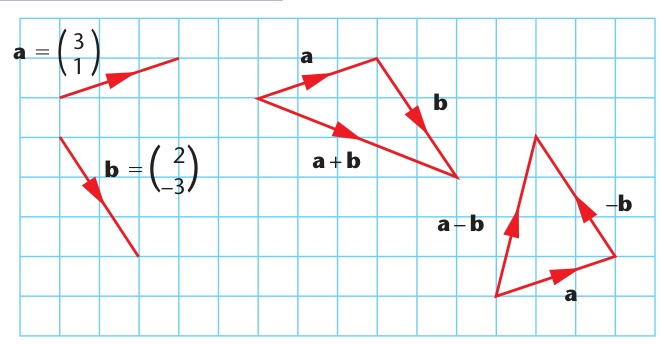
Every solution explains the mathematical method and gives the result.
\(\binom24+\binom{-3}1\).
\(\binom{2-3}{4+1}=\boxed{\binom{-1}{5}}\).
Find \(\binom5{-2}-\binom{-1}4\).
\(\binom{5-(-1)}{-2-4}=\boxed{\binom6{-6}}\).
A journey has vectors \(\binom3{-1}\), \(\binom{-5}4\) and \(\binom23\). Find the overall displacement.
Add horizontal components \(3-5+2=0\); vertical \(-1+4+3=6\). Result \(=\boxed{\binom06}\).
Subtopic 5
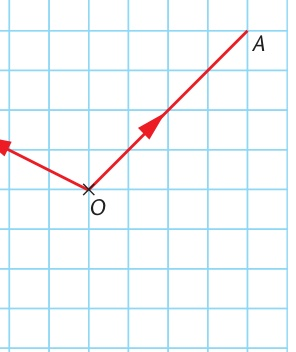
A position vector starts at the origin \(O\). If point \(P\) has coordinates \((x,y)\), then \(\overrightarrow{OP}=\binom xy\). To move from one point to another, subtract their position vectors.
\(\overrightarrow{AB}=\overrightarrow{OB}-\overrightarrow{OA}\), and \(\overrightarrow{OA}=\mathbf a\Rightarrow\overrightarrow{AO}=-\mathbf a\).
Exam tip: Keep the arrow direction fixed when subtracting endpoint vectors.
Every solution explains the mathematical method and gives the result.
Point \(P=(-2,5)\). Find \(\overrightarrow{OP}\).
\(\boxed{\overrightarrow{OP}=\binom{-2}{5}}\).
\(\overrightarrow{OA}=\binom13\) and \(\overrightarrow{OB}=\binom6{-2}\). Find \(\overrightarrow{AB}\).
\(\overrightarrow{AB}=\binom6{-2}-\binom13=\boxed{\binom5{-5}}\).
\(\overrightarrow{OA}=\binom{-4}2\) and \(\overrightarrow{AB}=\binom75\). Find \(B\).
\(\overrightarrow{OB}=\overrightarrow{OA}+\overrightarrow{AB}=\binom{-4+7}{2+5}=\binom37\). Thus \(\boxed{B=(3,7)}\).
Subtopic 6
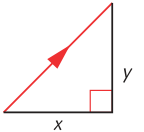
Magnitude means length, not direction. Horizontal and vertical components form a right triangle, so Pythagoras’ theorem gives the vector length. Magnitude cannot be negative.
\(\left|\binom xy\right|=\sqrt{x^2+y^2}\). For a displacement from \(A\) to \(B\), use the components of \(\overrightarrow{AB}\).
Exam tip: Square negative components carefully; their squares are positive.
Every solution explains the mathematical method and gives the result.
Find \(\left|\binom34\right|\).
\(\sqrt{3^2+4^2}=\sqrt{25}=\boxed5\).
Find the length of \(\binom{-5}{12}\).
\(\sqrt{(-5)^2+12^2}=\sqrt{169}=\boxed{13}\).
Find the distance from \(A(-2,1)\) to \(B(4,9)\).
\(\overrightarrow{AB}=\binom68\). Distance \(=\sqrt{6^2+8^2}=\boxed{10}\) units.
Subtopic 7
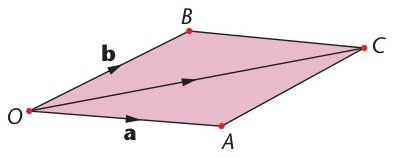
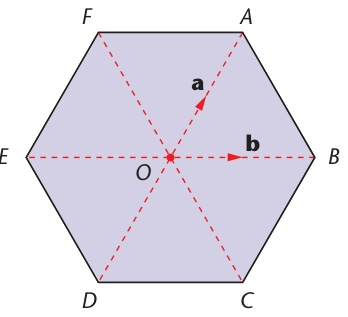
Use routes between vertices to prove properties without measuring a diagram. Opposite sides of a parallelogram are equal vectors when taken in corresponding directions. A midpoint divides a displacement into equal halves; a point in a given ratio divides its segment into proportional vector parts.
\(\overrightarrow{AC}=\overrightarrow{AB}+\overrightarrow{BC}\); midpoint \(M\) of \(AB\): \(\overrightarrow{OM}=\tfrac12(\mathbf a+\mathbf b)\). If \(AP:PB=m:n\), then \(\overrightarrow{OP}=\frac{n\mathbf a+m\mathbf b}{m+n}\).
Exam tip: When proving parallel lines, show one vector is a scalar multiple of the other; explain why the ratios match.
Every solution explains the mathematical method and gives the result.
In a parallelogram \(OABC\), \(\overrightarrow{OA}=\mathbf a\) and \(\overrightarrow{OC}=\mathbf c\). Find \(\overrightarrow{OB}\).
Travel \(O\to A\to B\); \(\overrightarrow{AB}=\mathbf c\). Thus \(\boxed{\overrightarrow{OB}=\mathbf a+\mathbf c}\).
Position vectors of \(A\) and \(B\) are \(\binom24\) and \(\binom{8}{-2}\). Find midpoint position.
\(\tfrac12\left(\binom24+\binom8{-2}\right)=\tfrac12\binom{10}{2}=\boxed{\binom51}\).
\(\overrightarrow{OA}=\mathbf a\), \(\overrightarrow{OB}=\mathbf b\). Point \(P\) divides \(AB\) in the ratio \(AP:PB=2:1\). Express \(\overrightarrow{OP}\).
\(\overrightarrow{AP}=\tfrac23(\mathbf b-\mathbf a)\). Therefore \(\overrightarrow{OP}=\mathbf a+\tfrac23(\mathbf b-\mathbf a)=\boxed{(\mathbf a+2\mathbf b)/3}\).
Questions are arranged by textbook subtopic. Within each section they start with confidence-building tasks and finish with extended examination-style reasoning. Try each question before opening its solution.
Move \((3,4)\) by \(\binom{2}{-1}\).
Step-by-step solution: \((3+2,4-1)=\boxed{(5,3)}\).
Find the vector from \((0,2)\) to \((5,7)\).
Step-by-step solution: \(\binom{5-0}{7-2}=\boxed{\binom55}\).
Find the vector taking \((-4,1)\) to \((1,-6)\).
Step-by-step solution: \(\binom{1-(-4)}{-6-1}=\boxed{\binom5{-7}}\).
Point \(X(8,-1)\) is the image of \(Y(2,3)\) under a translation. Find the translation vector.
Step-by-step solution: Image minus original: \(\binom{8-2}{-1-3}=\boxed{\binom6{-4}}\).
A triangle \(A(0,0),B(4,0),C(1,3)\) moves by \(\binom{-2}{-5}\). State all image vertices.
Step-by-step solution: \(A^\prime=(-2,-5),\ B^\prime=(2,-5),\ C^\prime=(-1,-2)\). Every point receives the same movement.
If \(\overrightarrow{CD}=\binom41\), find \(\overrightarrow{DC}\).
Step-by-step solution: Negate both components: \(\boxed{\binom{-4}{-1}}\).
Which equals \(\mathbf v=\binom{-2}{3}\): \(\binom{2}{-3}\) or \(\binom{-2}{3}\)?
Step-by-step solution: The second has the same components: \(\boxed{\binom{-2}{3}}\).
If \(\overrightarrow{AB}=\mathbf t\), write \(\overrightarrow{BA}\) using \(\mathbf t\).
Step-by-step solution: Reverse direction: \(\boxed{-\mathbf t}\).
If \(\overrightarrow{AB}=\mathbf a\), \(\overrightarrow{BC}=\mathbf b\), write \(\overrightarrow{AC}\).
Step-by-step solution: Follow the route A–B–C: \(\boxed{\mathbf a+\mathbf b}\).
For a closed triangle, simplify \(\overrightarrow{AB}+\overrightarrow{BC}+\overrightarrow{CA}\).
Step-by-step solution: The route returns to its start, so the resultant is \(\boxed{\mathbf0}\).
Calculate \(3\binom21\).
Step-by-step solution: \(\boxed{\binom63}\).
Calculate \(-2\binom{-4}{3}\).
Step-by-step solution: \(\boxed{\binom8{-6}}\).
Find \(\tfrac12\binom8{-6}\).
Step-by-step solution: \(\boxed{\binom4{-3}}\).
If \(\mathbf a=\binom{-3}{5}\), find \(4\mathbf a\).
Step-by-step solution: \(4\mathbf a=\boxed{\binom{-12}{20}}\).
Are \(\binom{10}{-15}\) and \(\binom{-2}{3}\) parallel? Explain.
Step-by-step solution: The first is \(-5\) times the second, so \(\boxed{\text{parallel}}\).
Add \(\binom13+\binom24\).
Step-by-step solution: \(\boxed{\binom37}\).
Subtract \(\binom52-\binom11\).
Step-by-step solution: \(\boxed{\binom41}\).
Find \(\binom{-3}5+\binom4{-2}\).
Step-by-step solution: \(\boxed{\binom13}\).
Simplify \(2\binom12-\binom{-3}5\).
Step-by-step solution: \(\binom24-\binom{-3}5=\boxed{\binom5{-1}}\).
A hiker moves \(\binom{6}{-1}\) km, then \(\binom{-2}{4}\) km. What vector takes the hiker directly back to the start?
Step-by-step solution: Total \(=\binom43\). Return vector is its negative: \(\boxed{\binom{-4}{-3}}\text{ km}\).
What is the position vector of \(Q(4,-1)\)?
Step-by-step solution: \(\boxed{\binom4{-1}}\).
\(A=(1,2)\), \(B=(6,3)\). Find \(\overrightarrow{AB}\).
Step-by-step solution: \(\binom{6-1}{3-2}=\boxed{\binom51}\).
If \(\overrightarrow{OA}=\binom{3}{-4}\), what is \(\overrightarrow{AO}\)?
Step-by-step solution: \(\boxed{\binom{-3}{4}}\).
If \(\overrightarrow{OA}=\binom14\) and \(\overrightarrow{AB}=\binom{-3}2\), find \(B\).
Step-by-step solution: \(\binom14+\binom{-3}2=\binom{-2}6\), so \(\boxed{B=(-2,6)}\).
\(A=(-3,2)\) and \(B=(5,-4)\). Express \(\overrightarrow{AB}\) and \(\overrightarrow{BA}\).
Step-by-step solution: \(\overrightarrow{AB}=\binom{8}{-6}\); reversing gives \(\overrightarrow{BA}=\boxed{\binom{-8}{6}}\).
Find the magnitude of \(\binom{6}{8}\).
Step-by-step solution: \(\sqrt{36+64}=\boxed{10}\).
Find \(\left|\binom{-3}{-4}\right|\).
Step-by-step solution: \(\sqrt9+\sqrt{16}\) is not the method; use \(\sqrt{9+16}=\boxed5\).
Find the magnitude of \(\binom{1}{2}\) to 2 d.p.
Step-by-step solution: \(\sqrt{1+4}=\sqrt5\approx\boxed{2.24}\).
How far apart are \(P(2,-3)\) and \(Q(5,1)\)?
Step-by-step solution: Displacement \(\binom34\), magnitude \(\sqrt{3^2+4^2}=\boxed5\) units.
A vector \(\mathbf v=\binom{x}{12}\) has magnitude 13. Find all possible values of \(x\).
Step-by-step solution: \(x^2+12^2=13^2\), so \(x^2=25\), giving \(\boxed{x=5\text{ or }-5}\).
If \(\overrightarrow{AB}=\mathbf a\) and \(\overrightarrow{BC}=\mathbf b\), write \(\overrightarrow{AC}\).
Step-by-step solution: Travel from A via B to C: \(\boxed{\mathbf a+\mathbf b}\).
If \(\overrightarrow{OA}=\mathbf a\) and \(\overrightarrow{OB}=\mathbf b\), find \(\overrightarrow{AB}\).
Step-by-step solution: \(\overrightarrow{AO}+\overrightarrow{OB}=-\mathbf a+\mathbf b=\boxed{\mathbf b-\mathbf a}\).
Find the midpoint of \(A(2,3)\) and \(B(8,7)\).
Step-by-step solution: \(\left(\frac{2+8}{2},\frac{3+7}{2}\right)=\boxed{(5,5)}\).
Show \(\binom{4}{6}\) and \(\binom{10}{15}\) are parallel.
Step-by-step solution: \(\binom{10}{15}=\tfrac52\binom46\). Since one is a scalar multiple of the other, they are parallel.
\(\overrightarrow{OA}=\binom10\), \(\overrightarrow{OB}=\binom{7}{12}\), and \(P\) divides \(AB\) in the ratio 1:2. Find \(P\).
Step-by-step solution: \(AP=\tfrac13AB=\tfrac13\binom6{12}=\binom24\). Add to \(A\): \(OP=\binom10+\binom24=\binom34\). Thus \(\boxed{P=(3,4)}\).
In a parallelogram \(OACB\), \(\overrightarrow{OA}=\mathbf a\), \(\overrightarrow{OB}=\mathbf b\) and \(M\) is the midpoint of \(AB\). Using vectors, prove that \(O\), \(M\) and \(C\) lie on a straight line. Give the ratio \(OM:MC\).
Step 1 — Find \(\overrightarrow{OC}\): The diagonal of the parallelogram is \(\overrightarrow{OC}=\mathbf a+\mathbf b\).
Step 2 — Use the midpoint rule: \(\overrightarrow{OM}=\frac12(\mathbf a+\mathbf b)\).
Step 3 — Prove collinearity: Because \(\overrightarrow{OM}=\frac12\overrightarrow{OC}\), the two vectors are parallel and have the same starting point \(O\). Hence \(O\), \(M\) and \(C\) are collinear.
Step 4 — State the ratio: \(M\) is halfway from \(O\) to \(C\), so \(\boxed{OM:MC=1:1}\).
Before the exam, practise without looking at the answers, check units and rounding, and write geometric or statistical reasons where they are needed.