2.3 Symmetric and asymmetric encryption
Encryption protects transmitted information by changing readable data into a form that should make no sense to an unauthorised person. This topic explains why encryption is needed, the meanings of plaintext and ciphertext, and how symmetric and asymmetric encryption use keys differently.
What you need to understand
By the end of Topic 2.3 you should be able to explain why encryption is used when data is transmitted over public networks; distinguish plaintext from ciphertext; describe symmetric encryption and its key-distribution problem; and describe how a matching public/private key pair is used in asymmetric encryption.
The purpose of encryption
Data sent over a public network, whether wired or wireless, can potentially be intercepted. The textbook calls a person who secretly intercepts transmitted data an eavesdropper. Encryption is used to reduce the danger of intercepted data being understood or used.
This is especially important for sensitive or confidential information, such as bank or credit-card details, medical information and legal documents.
Plaintext and ciphertext
Plaintext
The original readable data before it has been encrypted.
Encryption algorithm
The process that transforms the plaintext using an encryption key.
Ciphertext
The encrypted form of the data after the encryption algorithm has been applied.
Decryption
The reverse process that uses the required key to recover the original plaintext.
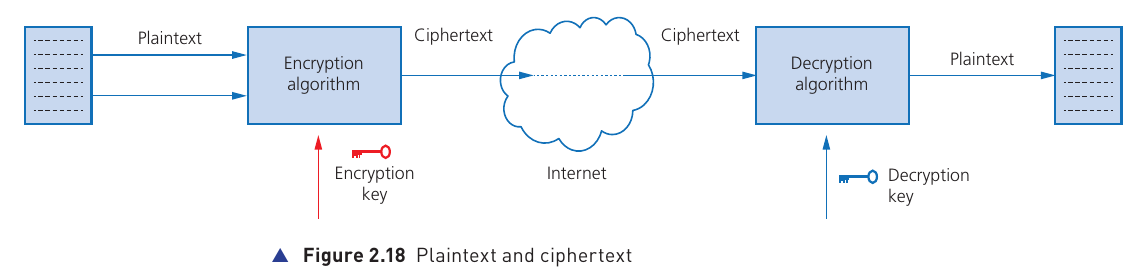
Symmetric and asymmetric encryption
Symmetric encryption
Symmetric encryption uses the same key to encrypt and decrypt a message. Both the sender and the intended receiver therefore need access to that secret key.
Simple textbook example
The book demonstrates the idea using a 10-digit denary key. Each key digit tells the system how many places to shift the next letter across the alphabet. The receiver reverses those shifts to recover the original message.
This is a teaching example of the principle. The textbook then notes that modern systems can use very large binary keys, giving an enormous number of possible combinations.

The textbook gives 256-bit binary keys as an example of a much stronger modern key size, with 2256 possible combinations (approximately 1.2 × 1077).
Asymmetric encryption
Asymmetric encryption was developed to address the security problem of sharing one secret key. Instead of one shared key, each user has a matching pair:
Public key
Can be made available to other people. It is used by a sender to encrypt data intended for the owner of the matching private key.
Private key
Is kept secret by its owner. It is used to decrypt data encrypted with the matching public key.
How the Tom-and-Jane example works
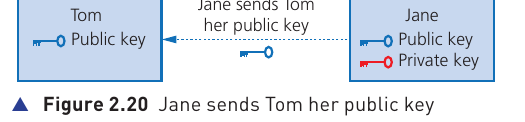
- Jane generates a matching pair of keys on her computer: one public key and one private key.
- Jane sends her public key to Tom. It does not need to be kept secret.
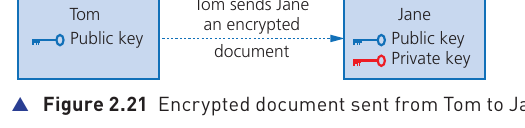
- Tom uses Jane's public key to encrypt the confidential document. The document is now ciphertext.
- Tom sends the ciphertext to Jane.
- Jane uses her matching private key to decrypt the document and recover the plaintext. Her public key cannot be used to decrypt that message.
Receiving encrypted data from many people
Jane can share the same public key with many people. Each person can use Jane's public key to encrypt a message for Jane, while Jane alone keeps the matching private key needed to decrypt those messages.
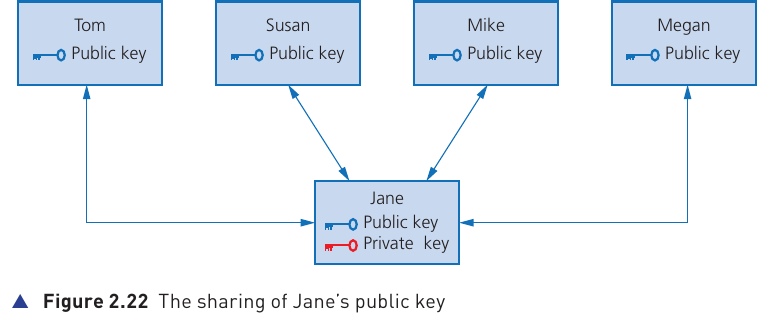
What if communication must work both ways?
Jane's key pair lets other people send encrypted information to Jane. For Jane to send encrypted information back to Tom, Tom must generate his own public/private key pair and give Jane his public key. Jane then encrypts the message using Tom's public key, and Tom decrypts it using his private key.
If several people all need secure two-way communication with one another, each person needs their own matching key pair, keeps their private key secret and shares their public key with the other users.
| Feature | Symmetric encryption | Asymmetric encryption |
|---|---|---|
| Keys used | One shared secret key is used for encryption and decryption. | A matching public/private key pair is used. |
| Key sharing | The secret key must somehow be given to the other party. | The public key can be shared; the private key remains secret. |
| Main issue highlighted in the textbook | Keeping the shared key secret during distribution. | Users need their own key pairs and public keys must be exchanged for two-way communication. |