6.2 Robotics
Robotics combines the design, construction and operation of physical robots. For IGCSE, you need to recognise what makes a machine a robot, distinguish independent from dependent robots, explain how robots use sensors, controllers, actuators and end-effectors, and evaluate their use in real situations.
What you need to understand
Do not think of every automated machine as an artificially intelligent robot. The source makes a clear distinction: a physical robot must be able to sense, have a degree of movement, and be programmable. Many robots repeatedly follow programmed instructions without possessing artificial intelligence. In exam questions, link the robot’s sensors to its controller, then explain how actuators and end-effectors produce the required physical action.
What is robotics?
Robotics is the branch of computer science concerned with the design, construction and operation of robots. A robot is a physical programmable machine that can interact with its surroundings and carry out tasks.
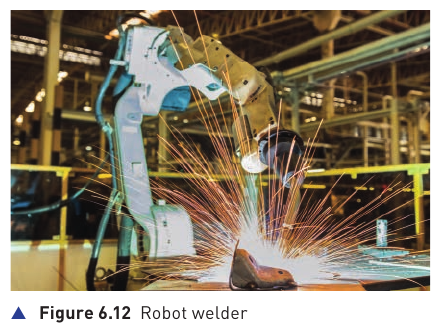
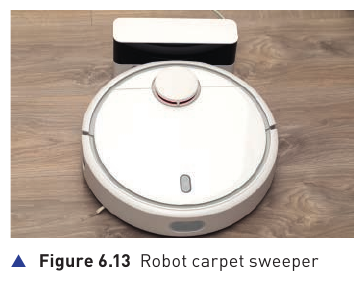
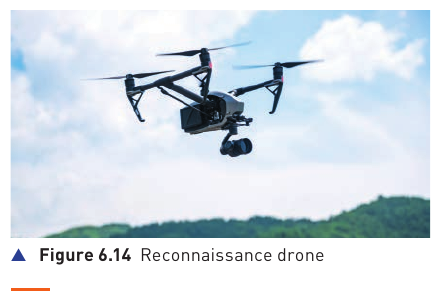
The source introduces robots through a wide range of uses. In factories they can weld, spray-paint car panels, fit windscreens, cut metal accurately, work on bottling and labelling lines, and locate items in warehouses. In the home they can sweep floors, cut grass, iron clothing, clean pools or windows and provide entertainment. Drones can be remotely controlled or autonomous and may be used for reconnaissance or deliveries.
Factories
Robots are suited to precise, repetitive or potentially hazardous physical work such as welding, spraying, cutting and handling components.
Home
Domestic robots can automate repeated chores such as vacuuming, mowing and cleaning, or operate as personal-assistant/entertainment devices.
Drones
Unmanned aerial vehicles can be remotely controlled or operate autonomously using embedded systems, cameras and sensors.
Characteristics of a robot
To be regarded as a robot in this topic, a device needs three key characteristics.
1. It senses its surroundings
Sensors such as light, pressure, temperature or acoustic sensors collect data about the environment. Sensor readings are sent to a microprocessor or computer so the robot can recognise conditions such as the presence, size, shape, weight or temperature of an object.
2. It has a degree of movement
Mechanical parts such as wheels, gears, pistons, motors, hydraulic systems and actuators allow the robot to turn, move, grip, lift or perform another physical action. Different end-effectors can be attached for jobs such as welding, spraying, cutting or lifting.
3. It is programmable
The robot has a controller — its control “brain” — which uses programs and incoming sensor/camera data to decide what action should be taken to perform its task.
Robotics and artificial intelligence are not the same thing
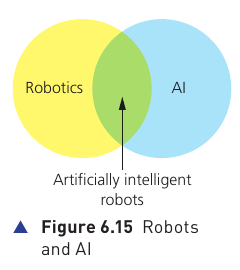
Many robots are not artificially intelligent. They simply repeat programmed actions rather than learning or adapting in a human-like way. Some artificially intelligent systems are not robots either because they have no physical robotic body. Only part of the two fields overlaps.
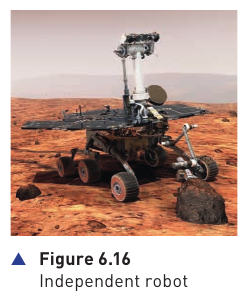
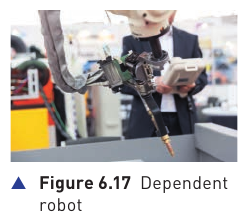
Independent and dependent robots
| Independent robot | Dependent robot |
|---|---|
| Operates without direct human control. | A human interfaces directly with the robot, for example through a control panel or computer. |
| Also described as autonomous. | Usually supplements human activity instead of replacing it completely. |
| Can carry out the human activity on its own once operating. | Human and robot may work together on the same process. |
The role of robots and their advantages and disadvantages
The source applies robotics to industry, transport, agriculture, medicine, domestic use and entertainment. In each case, exam answers should connect the physical task to the robot’s sensors, controller/microprocessor, actuators and, where relevant, end-effectors.
Industry
Industrial robots range from machines that lift heavy objects to systems that perform delicate manufacturing work. Uses include spraying car bodies, welding, manufacturing microchips and electrical products, and moving goods in automatic warehouses.
How industrial robots are programmed
- The robot can be given a stored sequence of instructions for the required task.
- Alternatively, a human operator can demonstrate the task. The robot arm may be guided manually, or sensors on the worker’s arm can record position and movement. Those movements are stored as instructions for the robot to repeat.
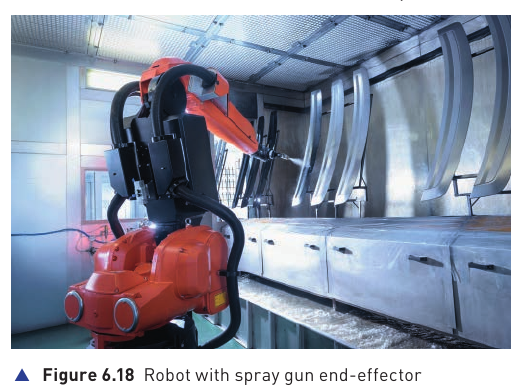
An end-effector is the attachment at the end of a robot arm that lets it perform a particular task. The same robot arm can carry different end-effectors for spraying, welding, cutting, gripping or lifting. Sensors also help prevent inappropriate actions — for example, stopping a spray operation if no car is present or if the paint supply has run out.
| Advantages of industrial robots | Disadvantages of industrial robots |
|---|---|
| Can work in environments that may be hazardous to people. | Can struggle with unusual or non-standard situations. |
| Can operate continuously without normal human breaks. | May reduce the number of manual jobs. |
| May be cheaper over the long term because fewer salaries are required. | Workers can lose practical skills as robots take over tasks. |
| High productivity and very consistent repeated actions. | Production may move to lower-cost locations, affecting employment elsewhere. |
| Well suited to boring and repetitive work, reducing errors caused by fatigue. | Robots are expensive to purchase, install and configure initially. |
| Factories can save on some heating and lighting needed for human workers. |
Transport
Autonomous transport systems use cameras, sensors, microprocessors/computers, software and actuators. Cameras provide visual information, while radar and ultrasonic systems can help build a three-dimensional picture of the surroundings. The processor interprets the data and sends commands to actuators controlling steering, gears, brakes, throttle and other systems.
Autonomous cars and buses
Consider a car approaching a red traffic light. The control system must recognise the signal, determine from its stored rules that it must stop, and send commands to the braking and gear-control actuators. It must keep checking cameras and sensors before moving again when the light turns green, because a pedestrian or broken-down vehicle may still make movement unsafe.
| Advantages of autonomous vehicles | Disadvantages of autonomous vehicles |
|---|---|
| Potentially safer because human driving errors are removed. | Very high initial technology and setup costs. |
| More efficient operation can reduce environmental impact. | Risk of the control system being hacked. |
| Smoother acceleration/braking can reduce stop-and-go congestion. | Software faults or poorly controlled updates could create serious safety problems. |
| Closer, more controlled spacing can increase road/lane capacity. | Sensors and cameras require reliable maintenance and can be affected by severe conditions. |
| Travel times may fall and parking can be less stressful. | Some drivers/passengers may be reluctant to trust the technology. |
| Reduced demand for some driving jobs may cause unemployment. |
Autonomous trains
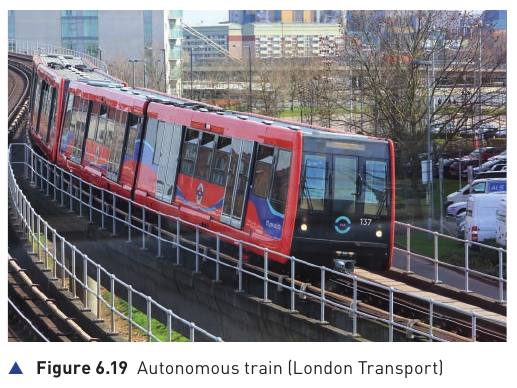
Driverless trains use sensors, cameras, actuators and on-board computers. The source highlights LiDaR (Light Detection and Ranging), which uses lasers to build a 3D image of the surroundings. Proximity sensors can help protect train doors, cameras can monitor conditions, and GPS can contribute to position, speed and direction calculations. Actuators control speed, braking and doors.
| Advantages of autonomous trains | Disadvantages of autonomous trains |
|---|---|
| Can improve punctuality. | Control systems may be targeted by hackers. |
| Lower running costs because fewer staff are required. | Very busy services can still be difficult to manage. |
| Human driving error is reduced, improving safety. | High initial capital and operating costs, including signalling/control equipment and staff training. |
| Better speed control can reduce energy use. | Passenger behaviour can interfere with safe operation, for example blocked doors. |
| Shorter safe intervals can allow more frequent trains. | Some passengers may resist driverless technology. |
| Schedules can be altered more easily for busy periods. | CCTV/monitoring remains necessary when no driver is present. |
Autonomous (unpiloted) airplanes
A fully autonomous aircraft would extend the automatic control already used in autopilot systems. The source mentions turbulence sensors, greater self-testing, automatic detection of cabin depressurisation, GPS for navigation/speed calculations and actuators controlling the throttle, wing flaps and rudder.
| Advantages of pilotless airplanes | Disadvantages of pilotless airplanes |
|---|---|
| Potentially improved passenger comfort. | Security problems may be harder to handle without pilots on board. |
| Lower running costs because fewer staff are needed. | Unexpected emergencies could be difficult to manage. |
| Removal of pilot-induced errors may improve safety. | There is a risk of hacking into flight-control systems. |
| No cockpit could allow a more aerodynamic front section. | Passengers may be reluctant to fly without pilots. |
| Software faults can have extremely serious consequences. |
Agriculture
Robots can replace repetitive, time-consuming agricultural work and let farmers focus on managing production. The source concentrates on five areas.
Harvesting and picking
Camera-equipped robots can judge whether fruit or vegetables are ready and use a robotic arm/cutting mechanism to harvest them accurately, improving speed and reducing waste.
Weed control
Robots can distinguish weeds from crops, use GPS to stay on course and operate a weed-removal blade through an actuator. A drone can first survey the field and provide route information.
Phenotyping
Robots use sensors, including spectral sensors and thermal cameras, to build a 3D picture of a plant and monitor its growth and health. Machine-learning methods can help identify abnormal leaves or disease symptoms.
Seeding and fertiliser distribution
Drones can map farmland, improve the accuracy of seed placement and distribute fertiliser more efficiently. The source also mentions cloud seeding by releasing silver iodide crystals.
Autonomous farm devices
Examples include grass cutters, weeders, pruners, harvesting robots, seeding robots and fertiliser-spraying robots. Sensors and cameras help them avoid obstacles and react to unsuitable weather.
Medicine
Robots can assist surgical procedures, monitor patients, perform some minor operations and disinfect rooms or operating theatres. The source also describes robots that take blood samples: they can locate a suitable vein more reliably, reduce risk to medical staff when a patient has an infectious disease, and free doctors and nurses for more skilled work.
Microbots can be used for targeted therapy. These very small robotic systems can carry drugs or treatments to a specific site, reducing damage to surrounding tissue. Modern prosthetic limbs can also behave like small robots: sensors and actuators, combined with bionic skins or neural interfaces, can provide feedback and more natural control.
Domestic robots
Domestic robots include autonomous vacuum cleaners and lawn mowers. Proximity sensors and cameras help them detect obstacles; a microprocessor controls the overall operation, and actuators drive motors so the device can move forwards, backwards and from side to side.
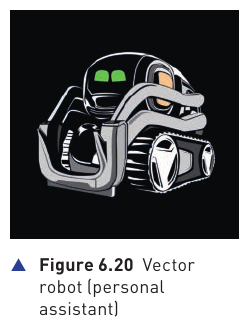
The source also gives a personal-assistant robot as an example. It can use cloud connectivity, a microphone for voice commands, an HD camera and computer vision for recognising faces, and proximity sensors plus actuators for navigating around a room.
Robots used in entertainment
Robots can appear in theme parks and venues, where autonomous character robots interact with visitors. At music events, robotic systems can coordinate lighting, laser effects and animation precisely with the music. In film and television, robots can control cameras, props and even move actors or objects to create effects that would be difficult or unsafe to achieve manually.
Humanoid robots can also perform stunt actions, often combined with CGI and image-capture techniques. Robotic control is particularly useful where movements, special effects and sound need to be synchronised with very high precision.