Natural numbers
The counting numbers
\(1,2,3,4,\ldots\)
In this course, natural numbers start at 1.
Build the number skills that support almost every later topic in Mathematics. These notes focus on recognising number types, using prime factors, and choosing HCF or LCM efficiently in both numerical and practical problems.
Subtopic 1
Different types of number overlap. For example, the number \(9\) is a natural number, an integer and a rational number. In an exam, classify a number using the definition that the question asks for rather than assuming each number belongs to only one group.
Exam distinction: an integer, a terminating decimal and a recurring decimal are all rational. A square root is rational when it simplifies to a rational value, such as \(\sqrt{49}=7\), but \(\sqrt{7}\) is irrational. The reciprocal of zero is undefined.
The counting numbers
In this course, natural numbers start at 1.
Positive and negative whole numbers, including zero.
Numbers that can be written as \(\frac{a}{b}\), where \(a\) and \(b\) are integers and \(b\neq0\).
Integers, terminating decimals and recurring decimals are rational.
Numbers that cannot be written as an exact fraction of two integers.
Their decimal forms do not terminate and do not recur, e.g. \(\sqrt2\) and \(\pi\).
Whole numbers with exactly two positive factors: 1 and themselves.
For example, \(2,3,5,7,11\). The number 1 is not prime.
A square number has the form \(n^2\); a cube number has the form \(n^3\).
Examples: \(25=5^2\), \(64=4^3=8^2\).
| Form | Type | Reason |
|---|---|---|
| \(-12\) | Rational | Every integer can be written as a fraction, e.g. \(-12=\frac{-12}{1}\). |
| \(0.375\) | Rational | It terminates: \(0.375=\frac{375}{1000}=\frac38\). |
| \(0.272727\ldots\) | Rational | The decimal repeats. |
| \(\sqrt{49}\) | Rational | \(\sqrt{49}=7\). |
| \(\sqrt{10}\) | Irrational | It is not the square root of a perfect square and its decimal neither terminates nor recurs. |
| \(3\pi\) | Irrational | A non-zero rational multiple of \(\pi\) remains irrational. |
For a non-zero number \(x\), its reciprocal is \(\frac1x\). Multiplying a number by its reciprocal gives 1.
Classify each number as integer, rational or irrational: \(-6,\ 0.45,\ \sqrt{36},\ \sqrt7\).
Step 1: \(-6\) is a whole number, so it is an integer. It is also rational because \(-6=\frac{-6}{1}\).
Step 2: \(0.45\) terminates, so it is rational.
Step 3: \(\sqrt{36}=6\), so it is an integer and rational.
Step 4: \(\sqrt7\) is not the square root of a perfect square, so it is irrational.
Explain why \(1.625\) is rational.
A terminating decimal can be written as a fraction:
\[1.625=\frac{1625}{1000}=\frac{13}{8}.\]Because \(13\) and \(8\) are integers and the denominator is not zero, \(1.625\) is rational.
Give an irrational number between 5 and 6, and justify your answer.
Since \(5^2=25\) and \(6^2=36\), choose a non-square integer between 25 and 36, for example 30.
\[25<30<36\quad\Rightarrow\quad 5<\sqrt{30}<6.\]Because 30 is not a perfect square, \(\sqrt{30}\) is irrational. So \(\boxed{\sqrt{30}}\) is a valid answer.
Classify \(-\frac{11}{4}\), \(\sqrt{81}\), and \(2\pi\) as rational or irrational.
Step 1: \(-\frac{11}{4}\) is a ratio of integers, so it is rational.
Step 2: \(\sqrt{81}=9\) is an integer, so it is rational.
Step 3: \(2\pi\) is irrational because a non-zero rational multiple of \(\pi\) is irrational.
A number is \(-1.25\). Find its reciprocal as a fraction and explain its number type.
Step 1: Write \(-1.25=-\frac54\).
Step 2: Invert numerator and denominator: \(\frac{1}{-5/4}=-\frac45\).
Step 3: The reciprocal is rational because it is a fraction of two integers.
Attempt the early questions first, then the exam-style question. Open Show Answer only after trying your own working.
Write the reciprocal of \(\frac{7}{9}\).
Step 1: Exchange numerator and denominator.
Step 2: \(\boxed{\frac97}\).
Is \(\sqrt{121}\) rational or irrational?
Step 1: \(\sqrt{121}=11\).
Step 2: 11 is an integer, hence rational.
Write \(0.375\) as a fraction and classify it.
Step 1: \(0.375=\frac{375}{1000}\).
Step 2: Divide numerator and denominator by 125: \(\boxed{\frac38}\), rational.
Identify which of \(\sqrt{18}\), \(\sqrt{\frac{9}{16}}\) and \(0.\overline{27}\) are rational.
Step 1: \(\sqrt{18}=3\sqrt2\) is irrational.
Step 2: \(\sqrt{\frac9{16}}=\frac34\) is rational.
Step 3: \(0.\overline{27}=\frac{27}{99}=\frac3{11}\) is rational.
Subtopic 2
A factor divides exactly into a number. A prime factor is a factor that is also prime. Every whole number greater than 1 that is not prime can be written as a product of prime factors.
Reliable method: keep dividing by prime numbers until the quotient is 1. Use indices to show repeated prime factors. A perfect square has even exponents in its prime factorisation; a perfect cube has exponents divisible by three.
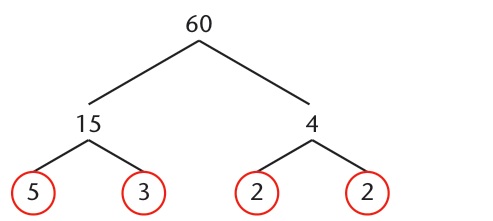
Whichever route you use, the final prime factorisation is the same apart from the order of the factors.
Express \(72\) as a product of prime factors.
Therefore, \(\boxed{72=2^3\times3^2}\).
Prime factorisation is especially useful when a question asks for the smallest multiplier that makes a number a perfect square or perfect cube.
Find the smallest positive integer \(k\) such that \(90k\) is a square number.
Prime factorise 90:
\[90=2\times3^2\times5.\]For a square, each exponent must be even. The powers of 2 and 5 are both 1, so multiply by another 2 and another 5:
\[k=2\times5=10.\]Check:
\[90\times10=900=30^2.\]So \(\boxed{k=10}\).
Find the smallest positive integer \(m\) such that \(108m\) is a cube number.
Prime factorise:
\[108=2^2\times3^3.\]For a cube, exponents must be multiples of 3. The exponent of 3 is already 3. The exponent of 2 is 2, so one more factor of 2 is needed:
\[m=2.\]Then
\[108\times2=216=6^3.\]Therefore, \(\boxed{m=2}\).
When the question says express as a product of prime factors, finish in prime factors only and use index notation where a prime repeats. Writing \(72=8\times9\) is not a final prime factorisation.
Write \(540\) as a product of prime factors.
Step 1: \(540=54\times10=(2\times3^3)\times(2\times5)\).
Step 2: Collect repeated factors: \(\boxed{540=2^2\times3^3\times5}\).
Find the smallest positive integer \(k\) for which \(72k\) is a perfect cube.
Step 1: \(72=2^3\times3^2\).
Step 2: For a cube, each prime exponent must be a multiple of 3.
Step 3: Multiply by one extra 3, so \(\boxed{k=3}\) and \(72k=216=6^3\).
Attempt the early questions first, then the exam-style question. Open Show Answer only after trying your own working.
Express \(84\) as a product of prime factors.
Step 1: \(84=2\times42=2\times2\times21\).
Step 2: \(\boxed{2^2\times3\times7}\).
Write \(360\) in prime factor form.
Step 1: \(360=36\times10=(2^2\times3^2)(2\times5)\).
Step 2: \(\boxed{2^3\times3^2\times5}\).
Find the smallest integer multiplying \(75\) to make a perfect square.
Step 1: \(75=3\times5^2\).
Step 2: 3 has an odd exponent; multiply by another 3.
Step 3: \(\boxed{k=3}\): \(225=15^2\).
Find the smallest integer \(k\) such that \(108k\) is a perfect cube.
Step 1: \(108=2^2\times3^3\).
Step 2: The exponent of 2 needs one more factor of 2.
Step 3: \(\boxed{k=2}\), making \(216=6^3\).
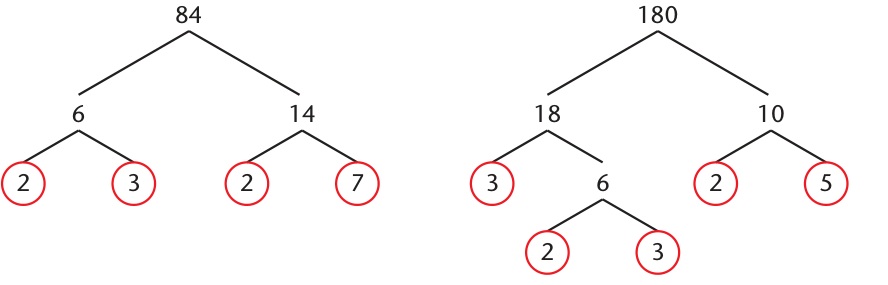
Choose the operation: use HCF when splitting items into the largest identical groups; use LCM for the earliest time repeating events coincide. In prime-factor form use the smaller exponents for HCF and the larger exponents for LCM.
Subtopic 3
The largest number that is a factor of every number being considered.
Think: largest equal group or largest equal size that divides exactly.
The smallest positive number that is a multiple of every number being considered.
Think: the first time repeating cycles or schedules coincide.
Write every number as a product of prime factors first.
Use only primes common to all the numbers, with the lowest power that appears in all of them.
Use every prime needed, with the highest power appearing in any of the numbers.
Reasonableness check: the HCF cannot be larger than the smallest number; the LCM cannot be smaller than the largest number.
Find the HCF and LCM of 48 and 72.
Prime factorise:
\[48=2^4\times3,\qquad72=2^3\times3^2.\]HCF: take the common primes with the lower powers:
\[\text{HCF}=2^3\times3=24.\]LCM: take all primes with the higher powers:
\[\text{LCM}=2^4\times3^2=144.\]So \(\boxed{\text{HCF}=24}\) and \(\boxed{\text{LCM}=144}\).
Find the HCF and LCM of 360 and 504.
Common prime factors with the lowest powers:
\[\text{HCF}=2^3\times3^2=72.\]All required prime factors with the highest powers:
\[\text{LCM}=2^3\times3^2\times5\times7=2520.\]Therefore, \(\boxed{72}\) and \(\boxed{2520}\).
A rectangular floor measures 168 cm by 126 cm. It is covered exactly with the largest possible identical square tiles. Find the side length of each tile.
The side length must divide exactly into both 168 and 126, and it must be as large as possible. So this is an HCF problem.
\[168=2^3\times3\times7,\qquad126=2\times3^2\times7.\]Use the common primes with the lowest powers:
\[\text{HCF}=2\times3\times7=42.\]The largest square tile has side length \(\boxed{42\text{ cm}}\).
Two warning lights flash together at 09:00. One flashes every 18 seconds and the other every 24 seconds. When will they next flash together?
We need the first time both repeating cycles coincide, so use the LCM.
\[18=2\times3^2,\qquad24=2^3\times3.\] \[\text{LCM}=2^3\times3^2=72\text{ seconds}.\]72 seconds is 1 minute 12 seconds. Therefore, they next flash together at \(\boxed{09{:}01{:}12}\).
Find the HCF and LCM of \(72\) and \(90\).
Step 1: \(72=2^3\times3^2\), \(90=2\times3^2\times5\).
Step 2: HCF \(=2^1\times3^2=\boxed{18}\).
Step 3: LCM \(=2^3\times3^2\times5=\boxed{360}\).
A floor measures \(252\text{ cm}\) by \(180\text{ cm}\). Find the greatest square-tile side length with no cutting, and how many tiles are needed.
Step 1: HCF of \(252\) and \(180\) is \(36\); the largest tile side is \(\boxed{36\text{ cm}}\).
Step 2: Tiles along each side: \(252\div36=7\), \(180\div36=5\).
Step 3: Total \(=7\times5=\boxed{35\text{ tiles}}\).
Attempt the early questions first, then the exam-style question. Open Show Answer only after trying your own working.
Find the HCF of \(24\) and \(36\).
Step 1: Common factors include 1, 2, 3, 4, 6, 12.
Step 2: Highest is \(\boxed{12}\).
Find the LCM of \(18\) and \(30\).
Step 1: \(18=2\times3^2\), \(30=2\times3\times5\).
Step 2: Use the greatest powers: \(2\times3^2\times5=\boxed{90}\).
Lights flash every 16 s and 24 s. They flash together now. How many seconds until they next coincide?
Step 1: \(16=2^4\); \(24=2^3\times3\).
Step 2: LCM \(=2^4\times3=\boxed{48\text{ s}}\).
One bus leaves every 28 minutes and another every 42 minutes. Both leave at 08:15. When do they next depart together?
Step 1: LCM of 28 and 42: \(28=2^2\times7\), \(42=2\times3\times7\), so LCM \(=84\) min.
Step 2: 84 min = 1 h 24 min.
Step 3: 08:15 + 1:24 = \(\boxed{09{:}39}\).
Practice
Start with the confidence questions, then move to the exam-style problems. Try each question before opening Show Answer. Every answer includes enough working to check your method as well as the final result.
From the list \(-9,\ 0,\ 14,\ 0.6,\ \sqrt{81},\ \sqrt{11}\):
a) Integers are whole numbers. Also \(\sqrt{81}=9\).
Integers: \(\boxed{-9,\ 0,\ 14,\ \sqrt{81}}\).
b) \(\sqrt{11}\) is not the root of a perfect square, so it is irrational.
Irrational: \(\boxed{\sqrt{11}}\).
State whether each number is rational or irrational and give a brief reason.
a) Rational — it terminates. \(2.75=\frac{11}{4}\).
b) Rational — it recurs.
c) Rational — \(\sqrt{121}=11\).
d) Irrational — \(\pi\) is irrational and multiplying it by the non-zero rational number 5 does not make it rational.
Write the reciprocal of each number.
Flip the number as a fraction:
a) \(\boxed{\frac18}\)
b) \(\boxed{\frac{12}{5}}\)
c) \(\boxed{-\frac43}\)
Express \(180\) as a product of prime factors in index form.
Break 180 into factors:
\[180=18\times10=(2\times3^2)(2\times5).\]Collect equal primes:
\[\boxed{180=2^2\times3^2\times5}.\]Find the smallest positive integer \(k\) such that \(150k\) is a square number.
For a square, all prime exponents must be even. The powers of 2 and 3 are each 1, so multiply by \(2\times3\).
\[k=6.\]Check: \(150\times6=900=30^2\).
\(\boxed{k=6}\)
Find the smallest positive integer \(m\) such that \(200m\) is a cube number.
The exponent of 2 is already a multiple of 3. The exponent of 5 is 2, so one more factor of 5 is needed.
\[m=5.\]Check: \(200\times5=1000=10^3\).
\(\boxed{m=5}\)
Find the HCF and LCM of 84 and 126. Show prime-factor working.
HCF uses common primes with the lower powers:
\[\text{HCF}=2\times3\times7=\boxed{42}.\]LCM uses the highest required powers:
\[\text{LCM}=2^2\times3^2\times7=\boxed{252}.\]Find the HCF and LCM of 24, 36 and 90.
HCF: common to all three with lowest powers:
\[\text{HCF}=2\times3=\boxed{6}.\]LCM: all primes with highest powers:
\[\text{LCM}=2^3\times3^2\times5=\boxed{360}.\]Write down an irrational number between 8 and 9. Show clearly why your number lies in this interval.
Since \(8^2=64\) and \(9^2=81\), choose a non-square integer between 64 and 81, such as 70.
\[64<70<81\Rightarrow8<\sqrt{70}<9.\]70 is not a perfect square, so \(\sqrt{70}\) is irrational.
One answer is \(\boxed{\sqrt{70}}\).
A rectangular sheet of card measures 300 mm by 225 mm. It is cut into identical square pieces with no card left over. Find the greatest possible side length of each square.
The side length must divide exactly into both dimensions, and it must be the greatest possible. Find the HCF.
\[300=2^2\times3\times5^2\] \[225=3^2\times5^2\] \[\text{HCF}=3\times5^2=75.\]Greatest possible side length: \(\boxed{75\text{ mm}}\).
A shuttle leaves a station every 28 minutes and another shuttle leaves every 42 minutes. They both leave at 07:30. At what time will they next leave together?
Find the LCM because the departures repeat.
\[28=2^2\times7,\qquad42=2\times3\times7\] \[\text{LCM}=2^2\times3\times7=84\text{ minutes}.\]84 minutes = 1 hour 24 minutes.
\(07{:}30+1{:}24=\boxed{08{:}54}\).
Two numbers are 360 and 756.
a)
\[360=2^3\times3^2\times5\] \[756=2^2\times3^3\times7\]b) HCF: use common primes with the lower powers:
\[2^2\times3^2=4\times9=\boxed{36}.\]c) LCM: use every prime with the highest power:
\[2^3\times3^3\times5\times7=8\times27\times35=\boxed{7560}.\]I can distinguish natural, integer, rational, irrational, prime, square and cube numbers.
I can give a final answer using prime factors and index notation.
I can use prime exponents to find the smallest multiplier.
I can decide which one a word problem needs and show the prime-factor method.
Chapter 1 revision: This chapter follows the subtopic headings and core concepts in the supplied Cambridge O Level Mathematics, Second Edition. Figure crops come from the provided textbook. Additional questions are original exam-style practice, not reproduced Cambridge examination questions.