Additional worked example 1 · Medium
Build a set from a rule
List \(A=\{\text{positive factors of }18\}\).
Step 1: Check which positive integers divide 18 without remainder.
Step 2: \(\boxed{A=\{1,2,3,6,9,18\}}\).
Learn the language of sets and use Venn diagrams accurately. The chapter builds from basic notation to complements, subsets, two-set counting and exam-style three-set problems.
Subtopic 1
A set is a collection of objects that satisfy a clear condition. The objects are called elements or members of the set. Sets are normally written inside curly brackets.
When listing elements, put each distinct element only once and use braces. A description must be unambiguous: “integers from 2 through 6” gives \(\{2,3,4,5,6\}\); writing only “integers” would not specify this finite set.
\(A=\{2,4,6,8\}\)
\(A=\{\text{positive even integers less than }10\}\)
List the elements of \(A=\{\text{factors of }20\}\).
Factors divide 20 exactly:
\[\boxed{A=\{1,2,4,5,10,20\}}.\]List \(A=\{\text{positive factors of }18\}\).
Step 1: Check which positive integers divide 18 without remainder.
Step 2: \(\boxed{A=\{1,2,3,6,9,18\}}\).
List the distinct letters in “STATISTICS” as a set and state the number of elements.
Step 1: Write each different letter once: S, T, A, I, C.
Step 2: \(A=\{S,T,A,I,C\}\) and \(\boxed{n(A)=5}\).
Attempt the early questions first, then the exam-style question. Open Show Answer only after trying your own working.
List the first five positive odd numbers as a set.
Step 1: The first five are 1, 3, 5, 7, 9.
Step 2: \(\boxed{\{1,3,5,7,9\}}\).
List the prime numbers smaller than 15.
Step 1: Prime numbers have exactly two factors.
Step 2: \(\boxed{\{2,3,5,7,11,13\}}\).
List the distinct letters of “MATHEMATICS” and find \(n(A)\).
Step 1: Keep each letter once: M,A,T,H,E,I,C,S.
Step 2: \(\boxed{n(A)=8}\).
Subtopic 2
The universal set, written \(\xi\), contains every element being considered in a particular problem. Smaller sets in the problem are taken from \(\xi\).
The universal set \(\xi\) fixes what is being considered. A complement depends on the chosen universal set, so it must be stated before identifying values outside a subset.
\(x\in A\) means “\(x\) is an element of \(A\)”.
\(x\notin A\) means “\(x\) is not an element of \(A\)”.
The same rule can give a different set when the universal set changes, because only elements inside \(\xi\) are allowed.
Let \(\xi=\{1,2,3,4,5,6,7,8,9,10\}\) and \(P=\{\text{prime numbers}\}\). List \(P\) and state whether \(9\in P\).
Since 9 is not prime, \(\boxed{9\notin P}\).
If \(\xi=\{1,2,3,4,5,6,7,8\}\) and \(A=\{2,4,6,8\}\), list \(A\) and all universal elements outside it.
Step 1: All of \(A\) is within \(\xi\).
Step 2: The outside elements are \(\boxed{\{1,3,5,7\}}\).
Let \(A=\{2,4,6\}\). Compare the elements outside \(A\) for \(\xi_1=\{1,2,3,4,5,6\}\) and \(\xi_2=\{1,2,\ldots,8\}\).
Step 1: For \(\xi_1\), outside \(A\) is \(\{1,3,5\}\).
Step 2: For \(\xi_2\), outside \(A\) is \(\{1,3,5,7,8\}\).
Step 3: The complement changes when the universal set changes.
Attempt the early questions first, then the exam-style question. Open Show Answer only after trying your own working.
If \(\xi=\{1,2,3,4,5\}\), can 6 belong to a subset of \(\xi\)?
Step 1: Every subset contains only elements of \(\xi\).
Step 2: \(\boxed{\text{No}}\), since 6 is not in the universal set.
Let \(\xi=\{1,2,\ldots,10\}\) and \(E\) contain all even elements. List the elements not in \(E\).
Step 1: \(E=\{2,4,6,8,10\}\).
Step 2: Not in \(E\): \(\boxed{\{1,3,5,7,9\}}\).
Given \(\xi=\{2,3,4,5,6,7,8,9\}\), \(P\) is the set of primes in \(\xi\). Find \(n(P)\) and the number outside \(P\).
Step 1: Primes are \(\{2,3,5,7\}\), so \(n(P)=4\).
Step 2: There are eight universal elements, hence \(8-4=\boxed4\) outside.
Subtopic 3
A Venn diagram shows sets visually. The rectangle represents the universal set \(\xi\), while circles or ovals represent the sets inside it. Before filling a diagram, decide which region each element belongs to.
Begin with the overlap when two sets share members, then place the “only” members, then finish with anything outside both circles. Overlapping circles mean the sets may share elements; disjoint circles mean they share none.
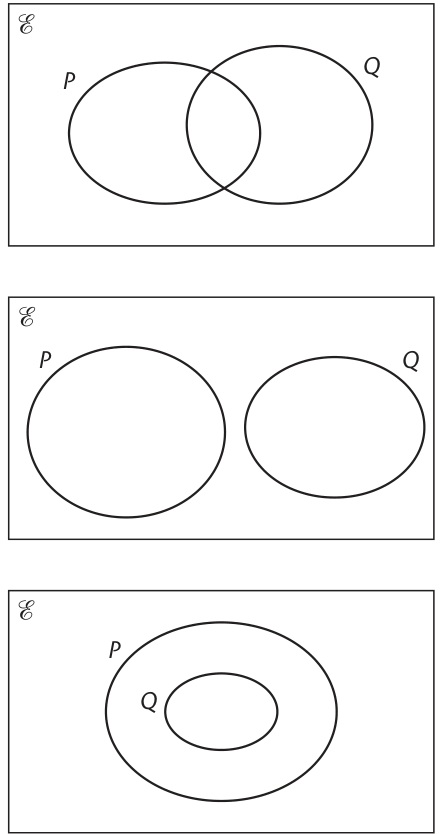
Some elements belong to both sets, so the circles overlap.
No element belongs to both sets, so \(P\cap Q=\varnothing\).
Every element of \(Q\) also belongs to \(P\), so \(Q\subseteq P\).
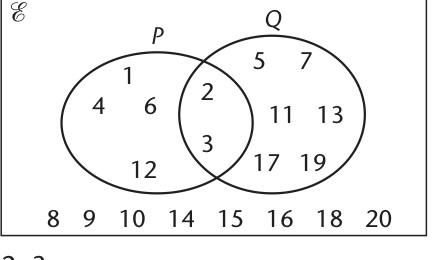
Let \(\xi=\{1,2,3,4,5,6,7,8,9,10,11,12\}\), \(P=\{\text{factors of }12\}\), and \(Q=\{\text{even numbers}\}\). Complete the Venn diagram.
First list each set:
\(P=\{1,2,3,4,6,12\}\)
\(Q=\{2,4,6,8,10,12\}\)
Both: \(\boxed{\{2,4,6,12\}}\)
\(P\) only: \(\boxed{\{1,3\}}\)
\(Q\) only: \(\boxed{\{8,10\}}\)
Neither: \(\boxed{\{5,7,9,11\}}\)
Visual check: overlap first, then the two “only” regions, then neither.
For \(\xi=\{1,2,3,4,5,6\}\), \(A=\{1,2,3\}\), \(B=\{3,4,5\}\), list each region.
Step 1: Both: \(A\cap B=\{3\}\).
Step 2: Only \(A=\{1,2\}\); only \(B=\{4,5\}\).
Step 3: Outside both \(=\{6\}\).
Let \(A\) be multiples of 4 and \(B\) be even numbers, with \(\xi=\{1,\ldots,12\}\). Explain the Venn arrangement.
Step 1: \(A=\{4,8,12\}\) and \(B=\{2,4,6,8,10,12\}\).
Step 2: Every element of \(A\) is in \(B\), so the \(A\) circle lies entirely inside \(B\).
Attempt the early questions first, then the exam-style question. Open Show Answer only after trying your own working.
If \(A=\{1,2\}\), \(B=\{3,4\}\), what goes in the overlap?
Step 1: There are no common members.
Step 2: The overlap is \(\boxed{\varnothing}\).
Let \(A=\{2,4,6\}\), \(B=\{4,5,6\}\). Give the only-\(A\) and only-\(B\) regions.
Step 1: Common region is \(\{4,6\}\).
Step 2: Only \(A=\boxed{\{2\}}\); only \(B=\boxed{\{5\}}\).
For \(\xi=\{1,\ldots,9\}\), \(A\) is even and \(B\) is a multiple of 3. List the four regions.
Step 1: \(A=\{2,4,6,8\}\) and \(B=\{3,6,9\}\).
Step 2: Both \(\{6\}\); only \(A\) \(\{2,4,8\}\); only \(B\) \(\{3,9\}\); outside \(\{1,5,7\}\).
Intersection means “in both”; union means “in at least one.” Count common elements only once in a union. Disjoint sets have intersection \(\varnothing\), but may still have a non-empty union.
Subtopic 4
\(A\cap B\) contains elements in both \(A\) and \(B\).
\(A\cup B\) contains elements in \(A\), in \(B\), or in both.
\(\varnothing\) has no elements. If \(A\cap B=\varnothing\), the sets are disjoint.
| Notation | Read it as | Region to think about |
|---|---|---|
| \(A\cap B\) | A and B | The overlap |
| \(A\cup B\) | A or B (or both) | Everything inside either circle |
| \(A\cap B'\) | In A and not in B | A-only region |
Shade only the overlap.
Shade both circles, including the overlap.
Shade the part of A outside B.
Given \(A=\{2,4,6,8\}\) and \(B=\{3,6,9\}\), find \(A\cap B\) and \(A\cup B\).
The only element in both sets is 6:
\[A\cap B=\boxed{\{6\}}.\]The union contains every element appearing in either set, written once:
\[A\cup B=\boxed{\{2,3,4,6,8,9\}}.\]Describe \(A\cap B'\) in words.
\(B'\) means “not in B”. Intersecting this with A gives the elements that are in A but not in B.
So \(A\cap B'\) is the \(\boxed{\text{A-only region}}\).
For \(A=\{1,3,5,7\}\) and \(B=\{3,6,7\}\), find \(A\cap B\) and \(A\cup B\).
Step 1: Common elements are 3 and 7, so \(\boxed{A\cap B=\{3,7\}}\).
Step 2: All distinct elements form \(\boxed{A\cup B=\{1,3,5,6,7\}}\).
In a club 25 play chess, 18 play draughts and 9 play both. Find how many play at least one.
Step 1: Add the group sizes: \(25+18=43\).
Step 2: Both were counted twice; subtract 9.
Step 3: \(n(C\cup D)=25+18-9=\boxed{34}\).
Attempt the early questions first, then the exam-style question. Open Show Answer only after trying your own working.
Find \(A\cap B\) for \(A=\{2,3,5\}\), \(B=\{3,4,5\}\).
Step 1: Find the elements in both sets.
Step 2: \(\boxed{\{3,5\}}\).
Find \(A\cup B\) for \(A=\{2,3,5\}\), \(B=\{3,4,5\}\).
Step 1: Combine distinct elements without repetition.
Step 2: \(\boxed{\{2,3,4,5\}}\).
If \(n(A)=21\), \(n(B)=17\) and \(n(A\cup B)=30\), find \(n(A\cap B)\).
Step 1: Use \(n(A\cup B)=n(A)+n(B)-n(A\cap B)\).
Step 2: \(30=21+17-x\), so \(\boxed{x=8}\).
Subtopic 5
The complement \(A'\) contains every element of the universal set that is not in \(A\).
The complement is taken within \(\xi\), not among all possible numbers. For compound expressions, handle the brackets first: \((A\cup B)'\) means outside both, while \((A\cap B)'\) means anywhere except the shared region.
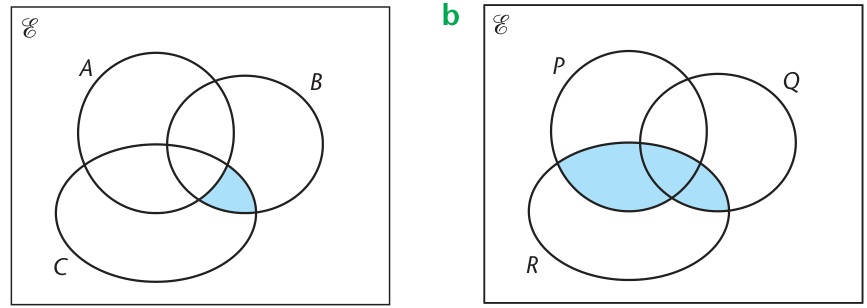
Everything in \(\xi\) except A.
Everything except the overlap.
Only the region outside both circles.
First find \(A\cap B\), then take everything not in that overlap.
First find \(A\cup B\), then take everything outside both sets.
The chapter also uses the equivalent relationships \((A\cap B)'=A'\cup B'\) and \((A\cup B)'=A'\cap B'\).
Let \(\xi=\{1,2,3,4,5,6,7,8,9,10\}\) and \(A=\{2,4,6,8,10\}\). Find \(A'\).
Remove the elements of \(A\) from the universal set:
\[\boxed{A'=\{1,3,5,7,9\}}.\]Let \(\xi=\{1,2,3,\ldots,12\}\), \(A=\{2,4,6,8,10,12\}\), and \(B=\{3,6,9,12\}\). Find \((A\cup B)'\).
First combine everything in A or B:
\(A\cup B=\{2,3,4,6,8,9,10,12\}\).
Now choose the elements of \(\xi\) that are outside that union:
\[\boxed{(A\cup B)'=\{1,5,7,11\}}.\]Let \(\xi=\{1,2,3,4,5,6,7\}\), \(A=\{1,2,3\}\), \(B=\{3,4\}\). Find \((A\cup B)^{\prime}\).
Step 1: \(A\cup B=\{1,2,3,4\}\).
Step 2: Within \(\xi\), the remaining elements are \(\boxed{\{5,6,7\}}\).
For the same sets, find \((A\cap B)^{\prime}\) and \(A^{\prime}\cup B^{\prime}\).
Step 1: \(A\cap B=\{3\}\), so its complement is \(\{1,2,4,5,6,7\}\).
Step 2: \(A^{\prime}=\{4,5,6,7\}\), \(B^{\prime}=\{1,2,5,6,7\}\).
Step 3: Their union is the same set, illustrating a De Morgan relationship.
Attempt the early questions first, then the exam-style question. Open Show Answer only after trying your own working.
In \(\xi=\{1,2,3,4,5\}\), let \(A=\{1,4\}\). Find \(A^{\prime}\).
Step 1: Remove the elements of \(A\) from \(\xi\).
Step 2: \(\boxed{\{2,3,5\}}\).
Let \(\xi=\{a,b,c,d,e\}\), \(A=\{a,b\}\), \(B=\{b,c\}\). Find \((A\cap B)^{\prime}\).
Step 1: \(A\cap B=\{b\}\).
Step 2: \(\boxed{\{a,c,d,e\}}\).
In a class of 40, \(n(A\cup B)=33\). How many are in \((A\cup B)^{\prime}\)?
Step 1: The complement of a union means neither set.
Step 2: \(40-33=\boxed7\).
Subtopic 6
\(A\subseteq B\) means every element of \(A\) is also an element of \(B\). A set is considered a subset of itself, and the empty set is a subset of every set.
A subset may equal the original set. The empty set is also a subset. A set of \(n\) distinct elements has \(2^n\) subsets; if the question asks for proper subsets, exclude the set itself.
\(A\subseteq B\): A is a subset of B.
\(A\not\subseteq B\): A is not a subset of B.
If a set has \(n\) elements, the number of subsets is
\[\boxed{2^n}.\]If \(Q\subseteq P\), every point in Q must lie inside P. Q may equal P, but it cannot contain an element outside P.
Example: if \(P=\{1,2,3,4\}\) and \(Q=\{1,3\}\), then \(Q\subseteq P\).
List all subsets of \(P=\{a,b,c\}\).
There should be \(2^3=8\) subsets:
\[\boxed{\varnothing,\{a\},\{b\},\{c\},\{a,b\},\{a,c\},\{b,c\},\{a,b,c\}}.\]How many subsets does \(A=\{p,q,r,s,t\}\) have?
Step 1: There are \(n=5\) distinct elements.
Step 2: Number of subsets \(=2^5=\boxed{32}\).
A set has 4 elements. How many non-empty proper subsets can it have?
Step 1: Total subsets \(=2^4=16\).
Step 2: Exclude the empty set and the complete set.
Step 3: \(16-2=\boxed{14}\).
Attempt the early questions first, then the exam-style question. Open Show Answer only after trying your own working.
Is \(\{2,4\}\) a subset of \(\{1,2,3,4\}\)?
Step 1: Both 2 and 4 belong to the larger set.
Step 2: \(\boxed{\text{Yes}}\).
List every subset of \(\{a,b\}\).
Step 1: Include empty, each singleton and the set itself.
Step 2: \(\boxed{\varnothing,\{a\},\{b\},\{a,b\}}\).
A set has 64 subsets. How many elements are in the set?
Step 1: Set \(2^n=64\).
Step 2: \(64=2^6\), so \(\boxed{n=6}\).
Subtopic 7
\(n(A)\) means the number of elements in set \(A\). In two-set problems, fill the intersection first so that people or objects counted in both sets are not counted twice.
For a two-set word problem, put the overlap in first, then calculate “only A” and “only B”. Check that four regions add to the full total: A only + both + B only + neither.
If the universal total is \(N\), then
\[\boxed{\text{neither}=N-n(A\cup B)}.\]In a group of 50 students, 31 study French, 27 study Spanish and 15 study both. How many study neither language?
Put the overlap in first:
Both languages: \(15\).
French only: \(31-15=16\).
Spanish only: \(27-15=12\).
At least one language:
\[16+15+12=43.\]Neither:
\[50-43=\boxed{7}.\]For two sets \(A\) and \(B\), \(n(A)=28\), \(n(B)=35\), and \(n(A\cup B)=50\). Find \(n(A\cap B)\).
Of 50 students, 28 study French, 23 study Spanish and 11 study both. How many study neither?
Step 1: At least one \(=28+23-11=40\).
Step 2: Neither \(=50-40=\boxed{10}\).
In a group of 80, 46 play football, 39 play volleyball, and 12 play neither. How many play both?
Step 1: At least one \(=80-12=68\).
Step 2: \(68=46+39-x\).
Step 3: \(x=\boxed{17}\) people play both.
Attempt the early questions first, then the exam-style question. Open Show Answer only after trying your own working.
Of 24 people, 15 like tea and 8 like coffee, with 4 liking both. How many like at least one?
Step 1: Use \(15+8-4\).
Step 2: \(\boxed{19}\).
Of 35 students, 20 play basketball, 17 swim and 7 do both. Find the number doing neither.
Step 1: At least one \(=20+17-7=30\).
Step 2: Neither \(=35-30=\boxed5\).
Of 70 visitors, 38 visited gallery A, 45 gallery B and 9 neither. How many visited only A?
Step 1: At least one \(=70-9=61\).
Step 2: Both \(=38+45-61=22\).
Step 3: Only A \(=38-22=\boxed{16}\).
Subtopic 8
Finite sets can often be listed. Infinite or algebraically defined sets are more efficiently written using a rule. The colon in set-builder notation is read as “where” or “such that”.
A set may be defined by listing its elements or by a rule, such as \(\{x:x\in\mathbb N,\ 1\le x\le6\}\). A set of ordered pairs also needs a condition specifying which pairs are allowed.
| Form | Example | Meaning |
|---|---|---|
| List | \(\{1,4,9,16,25\}\) | The elements are written explicitly. |
| Rule | \(\{x:x\text{ is a natural number}\}\) | All natural-number values of \(x\). |
| Inequality | \(\{x:2<x<6\}\) | Values of \(x\) between 2 and 6. |
| Ordered pairs | \(\{(x,y):y=2x+1\}\) | All points satisfying the equation. |
Let \(\xi=\{x:x\text{ is an integer}\}\) and \(P=\{x:-3<x\le2\}\). List \(P\).
The allowed integers are greater than −3 and up to 2 inclusive:
\[\boxed{P=\{-2,-1,0,1,2\}}.\]List \(B=\{x:x\text{ is an integer and }-2\le x<3\}\).
Step 1: Start at \(-2\) (included) and stop before 3.
Step 2: \(\boxed{B=\{-2,-1,0,1,2\}}\).
List \(T=\{(x,y):y=2x+1,\ x\in\{0,1,2,3\}\}\).
Step 1: For \(x=0,1,2,3\), calculate \(y=1,3,5,7\).
Step 2: \(\boxed{T=\{(0,1),(1,3),(2,5),(3,7)\}}\).
Attempt the early questions first, then the exam-style question. Open Show Answer only after trying your own working.
List \(\{x:x\text{ is a whole number, }0\le x<5\}\).
Step 1: Include 0, but exclude 5.
Step 2: \(\boxed{\{0,1,2,3,4\}}\).
Write \(\{4,9,16,25\}\) as a simple mathematical rule.
Step 1: These are squares of 2, 3, 4 and 5.
Step 2: \(\boxed{\{n^2:n\in\{2,3,4,5\}\}}\).
List \(\{(x,y):y=x^2,\ x\in\{-2,-1,0,1\}\}\).
Step 1: Square each allowed value of \(x\).
Step 2: \(\boxed{\{(-2,4),(-1,1),(0,0),(1,1)\}}\).
Subtopic 9
Three-set Venn diagrams have seven regions inside the circles plus the region outside all three. The key idea is to work from the most restricted region outward.
In a three-set diagram, fill the middle (all three) first. Subtract it from every stated pairwise intersection, then calculate each “only” section. Finally subtract all seven inside regions from the universal total.
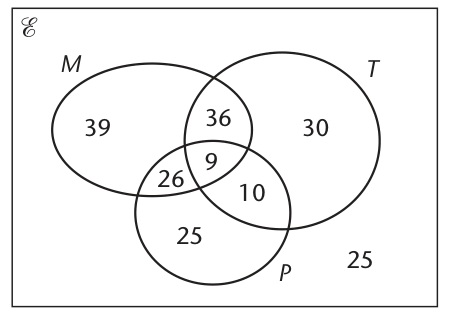
Elements in A that are also in B or C. This includes the triple intersection.
Elements in both A and B, but not in C: the A–B pair-only region.
In a year group of 180 students, 95 study Mathematics \((M)\), 80 study Science \((S)\), and 70 study Art \((A)\). Also, 40 study \(M\cap S\), 32 study \(M\cap A\), 28 study \(S\cap A\), and 12 study all three. Find the number who study none.
Step 1: triple intersection = 12.
Step 2: pair-only regions
\[MS=40-12=28\]\[MA=32-12=20\]\[SA=28-12=16\]Step 3: single-only regions
\[M=95-28-20-12=35\]\[S=80-28-16-12=24\]\[A=70-20-16-12=22\]Step 4: total inside
\[35+24+22+28+20+16+12=157\]Step 5: none
\[180-157=\boxed{23}.\]Fill the centre first, then pair-only regions, then single-only regions.
What does \(M\cap(T\cup P)\) represent?
First, \(T\cup P\) means “in T or P (or both)”. Intersecting with M keeps only the parts that are also in M.
So the required region is:
In words: \(\boxed{\text{students in M who also study T or P}}\).
A statement such as \(n(A\cap B)=40\) normally includes those who are also in C. If 12 are in all three, the A–B only region is \(40-12=28\).
If \(n(A\cap B)=12\), \(n(A\cap B\cap C)=5\), how many are in \(A\cap B\) but not \(C\)?
Step 1: The pairwise intersection includes the three-way region.
Step 2: \(12-5=\boxed7\), which is \(n(A\cap B\cap C^{\prime})\).
In a group of 60, 25 do A, 22 do B, 19 do C; pairwise intersections are 10, 8 and 7; 4 do all three. Find how many do none.
Step 1: Use inclusion–exclusion for three sets.
Step 2: At least one \(=25+22+19-10-8-7+4=45\).
Step 3: None \(=60-45=\boxed{15}\).
Attempt the early questions first, then the exam-style question. Open Show Answer only after trying your own working.
If 9 belong to \(A\cap B\) and 3 to all three sets, how many belong to A and B only?
Step 1: Subtract the centre from the pairwise total.
Step 2: \(9-3=\boxed6\).
In 3 sets, 6 people belong to exactly one set, 9 to exactly two and 3 to all three. Find the number in the union.
Step 1: The inside regions are disjoint when grouped by how many sets.
Step 2: \(6+9+3=\boxed{18}\).
Among 100 students, \(n(A)=40\), \(n(B)=35\), \(n(C)=30\), \(n(A\cap B)=12\), \(n(A\cap C)=10\), \(n(B\cap C)=8\), and \(n(A\cap B\cap C)=4\). Find the number doing none.
Step 1: At least one \(=40+35+30-12-10-8+4=79\).
Step 2: None \(=100-79=\boxed{21}\).
Start with notation and straightforward set work, then move into visual Venn-diagram questions and full exam-style problems. Try every question before opening Show Answer.
List the set \(A=\{\text{multiples of 5 less than 30}\}\).
The positive multiples of 5 below 30 are 5, 10, 15, 20 and 25.
\[\boxed{A=\{5,10,15,20,25\}}.\]Let \(P=\{2,3,5,7,11,13\}\). Write \(\in\) or \(\notin\) in each statement:
7 and 13 are listed in the set; 9 is not.
a) \(7\in P\)
b) \(9\notin P\)
c) \(13\in P\)
Given \(A=\{1,3,5,7,9\}\) and \(B=\{2,3,5,8\}\), find:
The elements common to both are 3 and 5:
\[A\cap B=\boxed{\{3,5\}}.\]The union contains every distinct element in either set:
\[A\cup B=\boxed{\{1,2,3,5,7,8,9\}}.\]Let \(\xi=\{1,2,3,4,5,6,7,8,9,10,11,12\}\) and \(C=\{1,2,3,4,6,12\}\). Find \(C'\).
Remove the elements of C from the universal set:
\[\boxed{C'=\{5,7,8,9,10,11\}}.\]List all subsets of \(\{p,q\}\).
A set with 2 elements has \(2^2=4\) subsets:
\[\boxed{\varnothing,\{p\},\{q\},\{p,q\}}.\]Let \(A=\{1,2,3,4,5\}\), \(B=\{2,4\}\), and \(C=\{2,6\}\). Complete the statements using \(\subseteq\) or \(\not\subseteq\).
a) Both 2 and 4 are in A, so \(\boxed{B\subseteq A}\).
b) 6 is not in A, so \(\boxed{C\not\subseteq A}\).
The purple part of the diagram is shaded. Write the region in set notation.
The shading is inside A but outside B.
\[\boxed{A\cap B'}\]The shaded region is outside both circles. Write it in set notation.
Everything inside A or B is excluded, so this is the complement of the union.
\[\boxed{(A\cup B)'}\]Equivalently, by De Morgan's law, \(A'\cap B'\).
The diagram shows the numbers of people in each region.
Find:
a) A includes A-only and the overlap: \(18+7=\boxed{25}\).
b) B includes B-only and the overlap: \(11+7=\boxed{18}\).
c) Union means all three inside regions: \(18+7+11=\boxed{36}\).
d) Include the 4 outside both circles: \(36+4=\boxed{40}\).
A set has 7 elements. How many subsets does it have?
Use \(2^n\):
\[2^7=\boxed{128}.\]Let \(P=\{x:x\text{ is an integer and }-2\le x<4\}\). List the elements of \(P\).
Start at −2 because it is included; stop before 4:
\[\boxed{P=\{-2,-1,0,1,2,3\}}.\]In a class of 40 students, 26 play football, 18 play basketball and 9 play both. Find the number who play neither.
At least one sport:
\[n(F\cup B)=26+18-9=35.\]Neither:
\[40-35=\boxed{5}.\]For two sets \(A\) and \(B\), \(n(A)=28\), \(n(B)=35\), and \(n(A\cup B)=50\). Find \(n(A\cap B)\).
Use
\[n(A\cup B)=n(A)+n(B)-n(A\cap B).\]So
\[50=28+35-n(A\cap B)\]\[n(A\cap B)=63-50=\boxed{13}.\]In the diagram, \(n(A)=22\).
Find \(x\).
Set A contains the A-only region and the overlap:
\[2x+(x+1)=22\]\[3x+1=22\]\[3x=21\]\[\boxed{x=7}.\]Of 75 people, 46 like tea, 38 like coffee and 21 like both. Find:
a) Tea only: \(46-21=\boxed{25}\).
b) Coffee only: \(38-21=\boxed{17}\).
c) At least one: \(25+21+17=63\). Therefore neither: \(75-63=\boxed{12}\).
In a group of 120 students, 62 study English \((E)\), 55 study History \((H)\), and 48 study Geography \((G)\). Also, 27 study \(E\cap H\), 24 study \(E\cap G\), 21 study \(H\cap G\), and 10 study all three. Find the number who study none.
First remove the triple intersection from the pair totals:
\[EH\text{ only}=27-10=17,\quad EG\text{ only}=24-10=14,\quad HG\text{ only}=21-10=11.\]Now single-only regions:
\[E\text{ only}=62-17-14-10=21\]\[H\text{ only}=55-17-11-10=17\]\[G\text{ only}=48-14-11-10=13.\]At least one:
\[21+17+13+17+14+11+10=103.\]None:
\[120-103=\boxed{17}.\]In a three-set Venn diagram, describe the region \(A\cap(B\cup C)\) in words and state which parts of A are included.
\(B\cup C\) means in B or C (or both). The intersection with A keeps only regions also inside A.
Included regions:
In words: \(\boxed{\text{elements in A that are also in B or C}}\).
Let \(\xi=\{1,2,3,\ldots,20\}\), \(A=\{\text{multiples of }2\}\) and \(B=\{\text{multiples of }3\}\). Find:
a) Numbers that are multiples of both 2 and 3 are multiples of 6:
\[A\cap B=\boxed{\{6,12,18\}}.\]b) First list the numbers in \(A\cup B\):
\(2,3,4,6,8,9,10,12,14,15,16,18,20\).
Numbers in \(\xi\) that are in neither set are
\[\boxed{(A\cup B)'=\{1,5,7,11,13,17,19\}}.\]I can use \(\in,\notin,\cup,\cap,\varnothing,A',\subseteq,\not\subseteq\) and \(n(A)\) correctly.
I can move between a Venn-diagram region and notation such as \(A\cap B'\), \((A\cup B)'\) and \(A\cap(B\cup C)\).
I fill the intersection first and can use \(n(A\cup B)=n(A)+n(B)-n(A\cap B)\) to solve unknown and “neither” questions.
I start with the triple intersection, subtract it from pair totals, then find single-only and outside regions.
Chapter 2 revision: This chapter follows the subtopic headings and core concepts in the supplied Cambridge O Level Mathematics, Second Edition. Figure crops come from the provided textbook. Additional questions are original exam-style practice, not reproduced Cambridge examination questions.