Square
\(7^2=7\times7=49\).
A square can also be visualised as the area of a square with equal side lengths.
Refresh the essential square, square-root, cube and cube-root facts you need throughout Mathematics, then practise using calculators confidently for other powers and roots.
Subtopic 1
To square a number, multiply it by itself. The notation \(a^2\) means \(a\times a\). A square root reverses this process: \(\sqrt{a}\) is the positive number whose square is \(a\).
Key distinction: the symbol \(\sqrt{a}\) denotes the principal (non-negative) square root. But an equation such as \(x^2=25\) has two solutions, \(x=\pm5\). Work out powers before adding or subtracting.
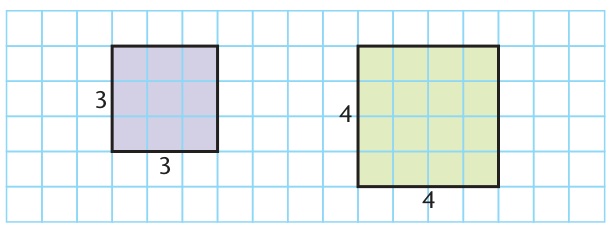

\(7^2=7\times7=49\).
A square can also be visualised as the area of a square with equal side lengths.
\(\sqrt{49}=7\) because \(7^2=49\).
The radical symbol means “the positive square root of”.
You should be able to recall these quickly without a calculator.
| Integer | 1 | 2 | 3 | 4 | 5 | 6 | 7 | 8 | 9 | 10 | 11 | 12 | 13 | 14 | 15 |
|---|---|---|---|---|---|---|---|---|---|---|---|---|---|---|---|
| Square | 1 | 4 | 9 | 16 | 25 | 36 | 49 | 64 | 81 | 100 | 121 | 144 | 169 | 196 | 225 |
Work out \(13^2\) and \(\sqrt{196}\) without a calculator.
From the square-number facts:
\[13^2=169\]and since \(14^2=196\),
\[\sqrt{196}=14.\]Work out \(9^2-5^2\).
Evaluate each power first:
\[9^2=81,\qquad5^2=25\]Then subtract:
\[81-25=\boxed{56}.\]Work out \(\sqrt{841}\) without using a square-root key.
We know \(30^2=900\), so the required integer is slightly below 30. Check 29:
\[29^2=841\]Therefore
\[\boxed{\sqrt{841}=29}.\]A square patio has area \(324\text{ m}^2\). Find its side length and perimeter.
If the side length is \(s\), then \(s^2=324\).
\[s=\sqrt{324}=18\text{ m}.\]The perimeter is
\[4\times18=\boxed{72\text{ m}}.\]Evaluate \(15^2-\sqrt{144}+3^2\).
Step 1: Calculate the powers and root: \(15^2=225\), \(\sqrt{144}=12\), \(3^2=9\).
Step 2: \(225-12+9=\boxed{222}\).
A square garden has area \(196\text{ m}^2\). A 2 m gate replaces part of its boundary. Find the length of fencing required.
Step 1: Side \(=\sqrt{196}=14\text{ m}\).
Step 2: Full perimeter \(=4\times14=56\text{ m}\).
Step 3: Fence required \(=56-2=\boxed{54\text{ m}}\).
Attempt the early questions first, then the exam-style question. Open Show Answer only after trying your own working.
Find \(\sqrt{169}\).
Step 1: \(13^2=169\).
Step 2: \(\boxed{13}\).
Work out \(17^2-12^2\).
Step 1: Calculate the squares: 289 and 144.
Step 2: \(289-144=\boxed{145}\).
Find all real solutions of \(x^2=81\).
Step 1: Both positive and negative 9 have square 81.
Step 2: \(\boxed{x=9\text{ or }x=-9}\).
A square courtyard has area \(324\text{ m}^2\). A 3 m opening is left in the perimeter. How much fencing is needed?
Step 1: Side \(=\sqrt{324}=18\text{ m}\).
Step 2: Perimeter \(=4\times18=72\text{ m}\).
Step 3: Fence \(=72-3=\boxed{69\text{ m}}\).
Subtopic 2
To cube a number, multiply it by itself three times. The notation \(a^3\) means \(a\times a\times a\). A cube root reverses this process: \(\sqrt[3]{a}\) is the number whose cube is \(a\).
Cubing is repeated multiplication three times: \(a^3=a\times a\times a\). Unlike square roots, cube roots of negative numbers are negative: \(\sqrt[3]{-125}=-5\). The textbook also asks you to use calculator powers other than 2 or 3.

\(4^3=4\times4\times4=64\).
A cube can be visualised as the volume of a cube whose three dimensions are equal.
\(\sqrt[3]{64}=4\) because \(4^3=64\).
Cube-root questions may be exact or require a calculator approximation.
| Integer | 1 | 2 | 3 | 4 | 5 | 10 |
|---|---|---|---|---|---|---|
| Cube | 1 | 8 | 27 | 64 | 125 | 1000 |
Use the square/cube keys where available, or the general power key for results such as \(2.4^5\).
Use square-root and cube-root keys for common roots. For other roots, use your calculator’s general \(n\)th-root function. Calculator layouts differ, so learn the keys on your own model.
Keep the full calculator value during working and round the final answer only when the question asks you to.
Work out \(5^3\) and \(\sqrt[3]{216}\).
Since \(6^3=216\),
\[\sqrt[3]{216}=\boxed{6}.\]Work out \(2.4^3\).
Work out \(\sqrt[3]{175}\), giving your answer to 2 decimal places.
To 2 decimal places:
\[\boxed{5.59}.\]A cube has volume \(350\text{ cm}^3\). Find its side length to 2 decimal places.
If the side length is \(s\), then
\[s^3=350\]so
\[s=\sqrt[3]{350}\approx7.047\ldots=\boxed{7.05\text{ cm}}.\]Work out \(1.6^5\) and \(\sqrt[4]{2401}\).
and because \(7^4=2401\),
\[\sqrt[4]{2401}=\boxed{7}.\]Calculate \(\sqrt[3]{512}+(-3)^3\).
Step 1: \(8^3=512\), so \(\sqrt[3]{512}=8\).
Step 2: \((-3)^3=-27\).
Step 3: \(8-27=\boxed{-19}\).
A cube has a volume of \(3375\text{ cm}^3\). Find the side and the total length of its twelve edges.
Step 1: Edge \(=\sqrt[3]{3375}=15\text{ cm}\).
Step 2: Twelve equal edges total \(12\times15=\boxed{180\text{ cm}}\).
Attempt the early questions first, then the exam-style question. Open Show Answer only after trying your own working.
Find \(\sqrt[3]{216}\).
Step 1: \(6^3=6\times6\times6=216\).
Step 2: \(\boxed6\).
Calculate \((-4)^3+\sqrt[3]{27}\).
Step 1: \((-4)^3=-64\), \(\sqrt[3]{27}=3\).
Step 2: \(-64+3=\boxed{-61}\).
Find \(\sqrt[3]{0.008}\).
Step 1: \(0.2\times0.2\times0.2=0.008\).
Step 2: \(\boxed{0.2}\).
A cube-shaped tank has volume \(0.125\text{ m}^3\). Find its edge in centimetres.
Step 1: Edge in metres \(=\sqrt[3]{0.125}=0.5\text{ m}\).
Step 2: Convert units: \(0.5\times100=\boxed{50\text{ cm}}\).
Start with quick recall, then move to calculator work and exam-style applications. Try each question before opening the solution.
Work out \(6^2\), \(11^2\) and \(15^2\).
Work out \(\sqrt{64}\), \(\sqrt{169}\) and \(\sqrt{225}\).
Work out \(12^2-7^2\).
Work out \(3^3\), \(4^3\) and \(10^3\).
Work out \(\sqrt[3]{8}\), \(\sqrt[3]{64}\) and \(\sqrt[3]{125}\).
Work out \(13^2-8^2+\sqrt{144}\).
Work out \(1.8^3\).
Work out \(\sqrt[3]{600}\), giving your answer to 2 decimal places.
Therefore \(\boxed{8.43}\).
Use a calculator to work out \(2.3^4\).
Work out \(\sqrt[4]{625}\).
Since \(5^4=625\),
\[\boxed{\sqrt[4]{625}=5}.\]Work out \(3^4+\sqrt{225}-\sqrt[3]{125}\).
A square field has area \(484\text{ m}^2\). Find the side length and perimeter.
so the perimeter is
\[4\times22=\boxed{88\text{ m}}.\]A cube has volume \(90\text{ cm}^3\). Find its side length to 2 decimal places.
so \(\boxed{s=4.48\text{ cm}}\).
A positive number \(x\) satisfies \(x^5=16807\). Find \(x\).
I know the square numbers from \(1^2\) to \(15^2\) and can reverse them to find exact square roots.
I know the key cube numbers and can reverse them to find exact cube roots.
I can use my own calculator for square roots, cube roots, general powers and other roots.
I keep full calculator values during working and round the final answer only when requested.
Chapter 3 revision: This chapter follows the subtopic headings and core concepts in the supplied Cambridge O Level Mathematics, Second Edition. Figure crops come from the provided textbook. Additional questions are original exam-style practice, not reproduced Cambridge examination questions.