Worked example · Easy
Estimate from a known height
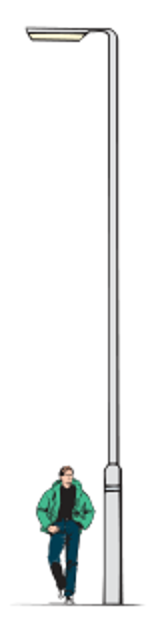
A signpost appears about three times as tall as a 1.7 m adult. Estimate the signpost height.
\[3\times1.7=5.1\text{ m}\]
A sensible estimate is about \(\boxed{5\text{ m}}\).
Round accurately, estimate intelligently and choose a sensible level of precision. The aim is not just to get an approximate answer, but to know whether that answer is reasonable.
Subtopic 1
An estimate should be realistic rather than exact. Compare an unknown length with a familiar length, then scale up or down.
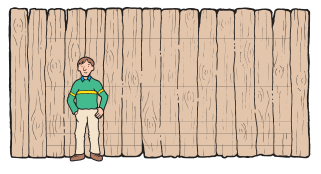
A motorway length should normally be in kilometres, a room height in metres, and the thickness of a book in millimetres or centimetres. An unreasonable unit can make a sensible number meaningless.
A signpost appears about three times as tall as a 1.7 m adult. Estimate the signpost height.
A sensible estimate is about \(\boxed{5\text{ m}}\).
Estimate the length of a classroom.
A classroom is several adult heights long, so metres are sensible. A reasonable estimate might be \(\boxed{8\text{ m}}\), not 8 cm or 8 km.
A bus is roughly 12 adult strides long. Each stride is about 0.75 m. Estimate the bus length.
\[12\times0.75=9\text{ m}\] So a sensible estimate is about \(\boxed{9\text{ m}}\).
Work each question first, then select Show Answer to reveal the steps.
Estimate the height of a classroom door in metres. Explain your benchmark.
Steps: A typical door is slightly taller than an adult (about 1.7 m). A sensible estimate is \(\boxed{2\text{ m}}\).
Which is the most sensible estimate for a pencil length: 18 mm, 18 cm or 18 m?
Steps: A pencil is shorter than a 30 cm ruler but much longer than 18 mm. Choose \(\boxed{18\text{ cm}}\).
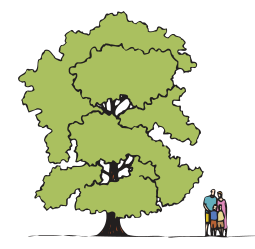
A tree in a picture is roughly four times the height of a 1.7 m person. Estimate its height.
Steps: Multiply the known height by 4: \[4\times1.7=6.8\text{ m}\] Give a rough answer: \(\boxed{7\text{ m}}\).
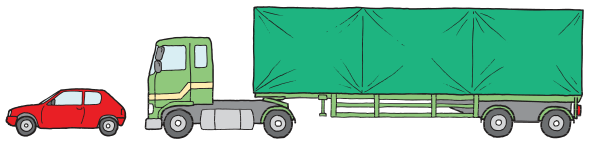
A truck appears 2.5 times the length of a 4 m car. Estimate the truck length.
Steps: \[4\times2.5=\boxed{10\text{ m}}\] The answer is an estimate, so do not imply centimetre accuracy.
A corridor is approximately 13 strides long. A stride is about 0.8 m. Estimate the corridor length to a sensible degree of accuracy.
Steps: \[13\times0.8=10.4\text{ m}\] Round a rough estimate appropriately: \(\boxed{10\text{ m}}\).
Subtopic 2
Decimal places are counted from the decimal point. To round, locate the final required decimal place and inspect the next digit.
Round \(7.4836\) to 2 d.p.
The hundredths digit is 8. The next digit is 3, so 8 stays unchanged.
\[7.4836\approx\boxed{7.48}\text{ (2 d.p.)}\]Round \(12.996\) to 2 d.p.
The third decimal digit is 6, so round the second decimal digit up.
\[12.996\to12.100\text{? No.}\]Rounding 9 hundredths up causes a carry:
\[\boxed{13.00}\text{ (2 d.p.)}\]For 2 d.p., the answer must show two decimal places. For example, write \(13.00\), not just 13, when the stated accuracy matters.
A measurement is 4.9996 cm. Round it to 3 decimal places, showing any carrying.
The fourth decimal digit is 6, so increase the third decimal place. The carry passes through 999: \[4.9996\approx\boxed{5.000\text{ cm}}\quad(3\text{ d.p.})\]
Work each question first, then select Show Answer to reveal the steps.
Round 6.734 to 2 decimal places.
Steps: The third decimal digit is 4, so retain the hundredths digit: \(\boxed{6.73}\).
Round 0.0987 to 3 decimal places.
Steps: The fourth digit is 7. Round the third decimal digit 8 up to 9: \(\boxed{0.099}\).
Round 27.995 to 2 decimal places.
Steps: The third decimal digit is 5: a carry passes through both 9s. \(\boxed{28.00}\) (2 d.p.).
Calculate 4.6 × 3.47 and give the result to 2 decimal places.
Steps: \[4.6\times3.47=15.962\] The third decimal digit is 2, so \(\boxed{15.96}\).
A square has side length 5.64 cm. Work out its area and round to 1 decimal place.
Steps: \[A=5.64^2=31.8096\text{ cm}^2\] The second decimal digit is 0, so \(\boxed{31.8\text{ cm}^2}\) (1 d.p.).
Subtopic 3
Significant figures are counted from the first non-zero digit. Zeros before that first non-zero digit are placeholders and are not significant.
| Number | First 3 significant digits | 3 s.f. |
|---|---|---|
| 52 684 | 5, 2, 6 | 52 700 |
| 0.007284 | 7, 2, 8 | 0.00728 |
| 17 082 | 1, 7, 0 | 17 100 |
Decimal places start counting immediately after the decimal point. Significant figures start at the first non-zero digit, wherever it occurs.
Round \(63\,482\) to 2 significant figures.
The first two significant digits are 6 and 3. The next digit is 4.
\[63\,482\approx\boxed{63\,000}\text{ (2 s.f.)}\]Round \(0.0047862\) to 3 significant figures.
Ignore the leading zeros. The first three significant digits are 4, 7, 8. The next digit is 6, so 8 rounds up.
\[0.0047862\approx\boxed{0.00479}\text{ (3 s.f.)}\]Round \(20.049\) to 4 significant figures.
The significant digits are 2, 0, 0, 4. The next digit is 9, so 4 rounds up.
\[20.049\approx\boxed{20.05}\text{ (4 s.f.)}\]Round 0.00099946 to 3 significant figures.
The significant digits begin at the first 9. The fourth significant digit is 4, so keep the first three 9s: \[0.00099946\approx\boxed{0.000999}\quad(3\text{ s.f.})\]
Work each question first, then select Show Answer to reveal the steps.
Round 83 624 to 2 significant figures.
Steps: Keep 8 and 3; the next digit is 6. \(\boxed{84\,000}\).
Round 0.006482 to 2 significant figures.
Steps: Ignore initial zeros. Keep 6 and 4; next digit 8 rounds up: \(\boxed{0.0065}\).
Round 7.996 to 3 significant figures.
Steps: Keep 7,9,9 and look at 6. Carry through the nines: \(\boxed{8.00}\), with the zeros showing 3 s.f.
Round 51 059 to 3 significant figures.
Steps: Keep 5,1,0; next digit 5 rounds 0 up: \(\boxed{51\,100}\).
The mass is 0.040958 kg. Give it to 3 significant figures and explain which zeros count.
Steps: The leading zeros are not significant; digits 4,0,9 are. Next digit 5 rounds 9 up: \(\boxed{0.0410\text{ kg}}\) (3 s.f.; the final zero is significant).
Subtopic 4
A reliable first method is to round each value to about 1 significant figure, then perform the easier calculation. Your final estimate should normally be given to only 1 or 2 significant figures.
Estimate \(38.7\times6.2\).
A club buys 47 shirts at $18.90 each. Estimate the total cost.
Estimate \(4.8\times3.7\) using 1 s.f. State whether your estimate is greater or less than the exact answer.
Both values were rounded up, so the estimate is greater than the exact product.
Estimate \(78.6\div24.3\) using convenient values. Is the estimate likely to be above or below the exact value?
The numerator was rounded up and the denominator down, so the estimate is likely to be above the exact quotient.
Rounding everything mechanically to 1 significant figure is not always best. Choose nearby numbers that make the calculation easy.
Choose numbers with useful common factors. For example, \(83.7\div2.87\) is easier as \(90\div3\) or \(81\div3\).
Round to a nearby perfect square such as 25, 36, 49, 64, 81 or 100.
Estimate \(294\div49.2\).
Choose nearby values that divide exactly:
\[294\approx300,\qquad49.2\approx50\]\[300\div50=\boxed6\]Estimate \(\sqrt{83}\).
The nearest convenient perfect square is 81.
\[\sqrt{83}\approx\sqrt{81}=\boxed9\]Estimate \(0.62\sqrt{47.8}\).
Use convenient values:
\[0.62\approx0.6,\qquad47.8\approx49\]\[0.6\sqrt{49}=0.6\times7=\boxed{4.2}\]Estimate \(\dfrac{29.6\times4.91}{0.49}\) using easy numbers.
Choose \(30\), \(5\) and \(0.5\): \[\frac{29.6\times4.91}{0.49}\approx\frac{30\times5}{0.5}=\boxed{300}\]
Work each question first, then select Show Answer to reveal the steps.
Estimate 49.2 × 2.9 by rounding to 1 significant figure.
Steps: \[49.2\approx50,\quad2.9\approx3\] \(50\times3=\boxed{150}\).
Estimate 318 ÷ 7.8 using convenient numbers.
Steps: \[318\approx320,\quad7.8\approx8\] \(320\div8=\boxed{40}\).
Estimate the area of a circle with radius 5.1 m by using \(\pi\approx3\).
Steps: \[A=\pi r^2\approx3\times5^2=\boxed{75\text{ m}^2}\]
Estimate \(0.79\sqrt{50}\) using a nearby square.
Steps: Use \(0.79\approx0.8\) and \(50\approx49\): \(0.8\sqrt{49}=0.8\times7=\boxed{5.6}\).
Estimate \(198\div9.7\). Is using \(200\div10\) guaranteed to give an overestimate?
Steps: \[200\div10=\boxed{20}\] No. Both the numerator and denominator increased, so their combined effect must be checked. The exact value is about \(20.41\), making 20 an underestimate.
Subtopic 5
An answer should suit both the context and the accuracy of the data used. Giving many extra digits does not make an answer more trustworthy.
Do not normally give a calculated answer to a greater degree of accuracy than the measurements or data used in the calculation.
A tabletop measures 1.82 m by 0.74 m, both to 2 decimal places. A calculator gives an area of 1.3468 m². Give a sensible answer.
The measurements were given to 2 d.p., so \(1.3468\text{ m}^2\) is unnecessarily precise.
\[\boxed{1.35\text{ m}^2}\]879 kg is the total mass of 13 people. Calculate a sensible average mass.
Individual body mass would not sensibly be reported to many decimal places here. A reasonable answer is \(\boxed{68\text{ kg}}\).
Keep full calculator accuracy during intermediate steps. Round the final answer unless the question specifically tells you to estimate first.
A measured length of 6.2 m is divided into 7 equal pieces. State a sensible quoted length for one piece.
\[6.2\div7=0.885714\ldots\text{ m}\] Since the length was given to 1 decimal place, quoting \(\boxed{0.89\text{ m}}\) is more sensible than a long decimal; the chosen accuracy should suit the purpose.
Work each question first, then select Show Answer to reveal the steps.
A measured mass is 4.6 kg. Is reporting it as 4.600000 kg justified?
Steps: No. The given value is only to 1 d.p.; adding unsupported zeros suggests extra precision.
A calculated length is 7.836 m. Give it to 1 decimal place.
Steps: The second decimal digit is 3, so \(\boxed{7.8\text{ m}}\).
A room measures 4.8 m by 3.1 m. Calculate its area to a sensible 1 d.p.
Steps: \[4.8\times3.1=14.88\text{ m}^2\] To 1 decimal place, \(\boxed{14.9\text{ m}^2}\).
A journey covers 178 km in 2.3 h. Calculate its speed to the nearest whole km/h.
Steps: \[178\div2.3=77.3913\ldots\] The required rounded speed is \(\boxed{77\text{ km/h}}\).
A shop needs 28 m of ribbon. Rolls each contain 6 m. How many whole rolls are needed, and why is ordinary rounding unsuitable?
Steps: \[28\div6=4.666\ldots\] You cannot buy part of a roll and 4 rolls are insufficient. Round UP: \(\boxed{5\text{ rolls}}\).
The early questions build rounding confidence. The later questions require you to choose sensible approximations and justify the direction or accuracy of an estimate.
Round a) \(8.374\) to 1 d.p. and b) \(0.04678\) to 3 d.p.
a) The next digit after 3 is 7, so \(8.374\to\boxed{8.4}\).
b) The first three decimal digits are 046; the next digit is 7, so \(0.04678\to\boxed{0.047}\).
Round a) \(58\,746\) to 2 s.f. and b) \(0.003864\) to 2 s.f.
a) First two significant digits 5, 8; next digit 7 → \(\boxed{59\,000}\).
b) First two significant digits 3, 8; next digit 6 → \(\boxed{0.0039}\).
Write \(0.006748\) to a) 2 d.p. and b) 2 s.f.
a) To 2 d.p., inspect the third decimal digit 6: \(\boxed{0.01}\).
b) Significant figures start at 6: 6, 7; next digit 4 → \(\boxed{0.0067}\).
Which is the most sensible estimate for the height of a classroom door: 2 mm, 2 cm, 2 m or 2 km?
A door is a little taller than an adult, so \(\boxed{2\text{ m}}\) is sensible.
Estimate \(62.4\times19.7\) by rounding each number to 1 s.f.
A rectangle is 7.8 cm by 4.2 cm. Estimate its area.
Estimate the cost of 31 cinema tickets at $12.70 each.
Other sensible nearby-number estimates may also be acceptable if the working is clear.
Estimate \(356\div58.4\) using convenient numbers.
Use \(360\div60\), which is easy and close to the original values.
\[360\div60=\boxed6\]Estimate \(\sqrt{67}\).
64 is a nearby perfect square.
\[\sqrt{67}\approx\sqrt{64}=\boxed8\]Estimate \(6.8\times4.6\) as \(7\times5\). Is the estimate greater or less than the exact product? Explain.
Both original values were rounded up, so the estimate is \(\boxed{\text{greater than the exact product}}\).
Estimate \(191\div12.4\) using \(200\div10\). Is the estimate likely to be above or below the exact answer?
The numerator has increased and the denominator has decreased, both of which make the quotient larger. So the estimate is \(\boxed{\text{above the exact value}}\).
A stadium attendance is 16 240 adults, 10 780 children and 8 190 seniors. A report says “about 35 000 people attended.” Explain why this is reasonable.
Round to convenient thousands:
\[16\,240\approx16\,000,\quad10\,780\approx11\,000,\quad8\,190\approx8\,000\]\[16\,000+11\,000+8\,000=\boxed{35\,000}\]A cuboid measures 3.82 cm by 5.13 cm by 1.94 cm. Estimate its volume.
Estimate \(1.18\sqrt{63.5}\).
Choose convenient values:
\[1.18\approx1.2,\qquad63.5\approx64\]\[1.2\sqrt{64}=1.2\times8=\boxed{9.6}\]A rectangle is measured as 4.7 m by 2.3 m, each to 1 decimal place. A calculator gives 10.81 m². State a sensible area and explain.
The measurements are only to 1 d.p., so giving many extra digits would suggest false precision. A sensible result is \(\boxed{10.8\text{ m}^2}\).
The masses of 9 parcels total 137 kg, measured to the nearest kilogram. Find the mean mass and give a sensible final answer.
Since the total was measured to the nearest kilogram, \(\boxed{15\text{ kg}}\) is a sensible level of accuracy for the mean.
For \(0.094768\), give a) 3 decimal places and b) 3 significant figures. Explain why the answers differ.
a) Decimal places count from the decimal point: \(0.094768\to\boxed{0.095}\).
b) Significant figures start at the first non-zero digit 9: digits 9,4,7; next digit 6, so \(\boxed{0.0948}\).
They differ because the two counting systems start in different places.
A journey of 487 km takes 6.2 hours. a) Estimate the average speed. b) The calculator value is 78.548… km/h. Give a sensible final answer.
a) Use convenient values:
\[487\approx480,\qquad6.2\approx6\]\[480\div6=\boxed{80\text{ km/h}}\]b) A sensible final value is \(\boxed{79\text{ km/h}}\) (or 78.5 km/h if the context specifically calls for 1 d.p.).
I compare with familiar benchmarks and always use sensible units.
I count from the decimal point and inspect the next digit before rounding.
I start at the first non-zero digit and keep placeholder zeros where necessary.
I show the rounded values I used and keep the final estimate suitably rough.
For division I choose useful factors; for roots I choose nearby perfect squares.
I do not present a final answer as more precise than the information used to calculate it.