Worked example · Easy
Evaluate a function
Given \(f(x)=3(x-2)\), find \(f(6)\).
\[f(6)=3(6-2)=3\times4=\boxed{12}\]
Learn how functions map inputs to outputs, how domain and range describe allowable values, how inverse functions undo a function, and how composite functions apply two functions in sequence.
Subtopic 1
A function is a rule that takes an input and produces an output. The mapping notation \(f:x\mapsto 2x-3\) means that function \(f\) maps \(x\) onto \(2x-3\). The same rule is commonly written as \(f(x)=2x-3\).
Given \(f(x)=3(x-2)\), find \(f(6)\).
Given \(f(x)=3(x-2)\), solve \(f(x)=6\).
Given \(f(x)=3(x-2)\), find and simplify \(f(x+4)\).
Replace every \(x\) in the rule by \(x+4\):
\[f(x+4)=3((x+4)-2)=3(x+2)=\boxed{3x+6}\]Let \(f(x)=2x-3\) and \(g(x)=7-2x\). Solve \(f(x)=g(x)\).
When substituting an expression, use brackets. For example, if \(h(x)=x^2-5\), then \(h(2x)=(2x)^2-5=4x^2-5\), not \(2x^2-5\).
Evaluate a function by substituting the entire input. Parentheses matter especially for negative numbers and algebraic expressions.
For \(f(x)=3x^2-2x\), find \(f(-2)\).
\(f(-2)=3(-2)^2-2(-2)=12+4=16\).
Given \(f(x)=2x-5\), find and simplify \(f(x+3)\).
\(f(x+3)=2(x+3)-5=2x+1\).
Question 1: If \(f(x)=4x-7\), find \(f(3)\).
\(4(3)-7=5\).
Question 2: If \(g(x)=x^2+1\), find \(g(-3)\).
\((-3)^2+1=10\).
Question 3: If \(f(x)=5x+2\), solve \(f(x)=27\).
\(5x+2=27\), so \(x=5\).
Question 4: For \(h(x)=x^2-2x\), simplify \(h(x+1)\).
\((x+1)^2-2(x+1)=x^2-1\).
Subtopic 2
The domain is the set of permitted input values. The range is the set of output values produced by those inputs. Mapping diagrams show this input-output relationship clearly.
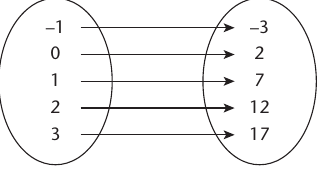
For \(g(x)=5x+2\) and domain \(\{-1,0,1,2,3\}\), find the range.
Substitute each input:
\(g(-1)=-3\), \(g(0)=2\), \(g(1)=7\), \(g(2)=12\), \(g(3)=17\).
Range: \(\boxed{\{-3,2,7,12,17\}}\).
Some rules exclude certain inputs. For example, in \(g(x)=\frac{2}{x-4}\), the value \(x=4\) is not allowed because it would make the denominator zero.
For \(g(x)=\frac{2}{x-4}\), explain why \(4\) cannot be in the domain.
If \(x=4\), then the denominator is \(4-4=0\). Division by zero is undefined, so \(\boxed{x\ne4}\).
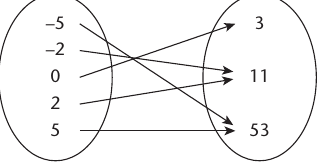
For \(h(x)=2x^2+3\) and domain \(\{-5,-2,0,2,5\}\), find the range.
\(h(-5)=53\), \(h(-2)=11\), \(h(0)=3\), \(h(2)=11\), \(h(5)=53\).
Repeated outputs are listed once in the range:
\(\boxed{\{3,11,53\}}\).
The domain is the set of allowed inputs. The range is the set of actual outputs. A finite domain must be evaluated point by point.
Find the range of \(f(x)=2x^2-1\) on \(\{-2,-1,0,1,3\}\).
Outputs are 7, 1, -1, 1, 17. The range is \(\{-1,1,7,17\}\) (no repeats).
Find the range of \(f(x)=(x-2)^2+3\) for real \(x\).
A squared quantity cannot be negative; smallest output is 3 at \(x=2\). Range is \(f(x)\ge3\).
Question 1: For domain \(\{-1,0,2\}\), find range of \(f(x)=x+4\).
Values 3, 4 and 6; range \(\{3,4,6\}\).
Question 2: Give the real domain of \(f(x)=1/(x-5)\).
All real numbers except \(x=5\), which makes the denominator zero.
Question 3: Find range of \(f(x)=x^2\) for real x.
\(f(x)\ge 0\), since squares are non-negative.
Question 4: For \(f(x)=x^2\) with \(1\le x\le 4\), find range.
On this non-negative interval, values increase from \(1^2=1\) to \(4^2=16\): \(1\le f(x)\le16\).
Subtopic 3
An inverse function reverses the action of the original function. If \(f\) maps an input to an output, then \(f^{-1}\) maps that output back to the original input.
Given \(f(x)=3x-5\), find \(f^{-1}(x)\).
Swap the role of the input variable:
\[\boxed{f^{-1}(x)=\frac{x+5}{3}}\]For the function above, find \(f^{-1}(7)\).
This is equivalent to finding the original input that gives \(f(x)=7\).
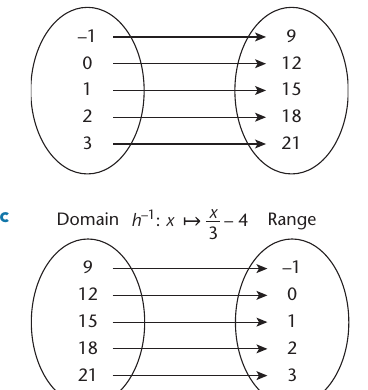
Given \(h(x)=\frac{12}{x+1}\), find \(h^{-1}(x)\).
Therefore:
\[\boxed{h^{-1}(x)=\frac{12}{x}-1}\]A true inverse must give only one output for each input. For functions such as \(h(x)=2x^2+3\), the original domain must be restricted if we want an inverse function. With the non-negative branch, the inverse is
\[h^{-1}(x)=\sqrt{\frac{x-3}{2}}\]and its domain is \(x\ge3\).
Substitute a value into the original function, then pass the result through the inverse. You should recover the starting value.
An inverse reverses a one-to-one mapping. Solve y=f(x) for x, then swap the labels. State domain restrictions where necessary.
Find \(f^{-1}(x)\) for \(f(x)=5x-3\).
Set \(y=5x-3\), rearrange \(x=(y+3)/5\), hence \(f^{-1}(x)=(x+3)/5\).
Find the inverse of \(f(x)=(x-1)^2\) with \(x\ge1\).
\(y=(x-1)^2\); restricted \(x-1\ge0\), so \(x=1+\sqrt y\). Thus \(f^{-1}(x)=1+\sqrt x\), with \(x\ge0\).
Question 1: Find inverse of \(f(x)=2x+7\).
\(y=2x+7\Rightarrow x=(y-7)/2\). Thus \(f^{-1}(x)=(x-7)/2\).
Question 2: Find inverse of \(f(x)=x/3-4\).
\(y=x/3-4\Rightarrow x=3(y+4)\), so \(f^{-1}(x)=3x+12\).
Question 3: Explain why \(f(x)=x^2\) has no inverse function over all real x.
Inputs 2 and -2 both give 4: not one-to-one. Restrict the domain, for example \(x\ge0\).
Question 4: Check inverse of \(f(x)=4x-1\) using \(f^{-1}(9)\).
\(f^{-1}(x)=(x+1)/4\), so \(f^{-1}(9)=10/4=2.5\), and \(f(2.5)=9\).
Subtopic 4
Composite functions apply one function and then another. The notation \(gf(x)\) means \(g(f(x))\): apply \(f\) first, then apply \(g\) to the result.

In general, \(gf(x)\neq fg(x)\). Read from right to left: in \(gf(x)\), do \(f\) first.
Let \(f(x)=2x+1\) and \(g(x)=3x-2\). Find \(gf(5)\).
First:
\[f(5)=2(5)+1=11\]Then:
\[g(11)=3(11)-2=\boxed{31}\]For the same functions, find \(gf(x)\).
For \(f(x)=2x+1\) and \(g(x)=3x-2\), find \(fg(x)\).
So \(gf(x)\) and \(fg(x)\) are different.
Let \(g(x)=3(x+5)\) and \(h(x)=x^2\). Find \(hg(x)\), then solve \(hg(x)=36\).
Now solve:
\[9(x+5)^2=36\]\[(x+5)^2=4\]\[x+5=\pm2\]\[\boxed{x=-3\text{ or }x=-7}\]In \(gf(x)=g(f(x))\), apply f first. The order can change the result, so always write the inner calculation.
If \(f(x)=x+2\) and \(g(x)=3x\), find \(gf(x)\).
\(g(f(x))=g(x+2)=3(x+2)=3x+6\).
If \(f(x)=x^2-1\) and \(g(x)=2x+3\), find \(fg(x)\).
\(f(g(x))=(2x+3)^2-1=4x^2+12x+8\).
Question 1: With \(f(x)=x+3\), \(g(x)=2x\), find \(gf(4)\).
First \(f(4)=7\), then \(g(7)=14\).
Question 2: With same f and g, find \(fg(4)\).
First \(g(4)=8\), then \(f(8)=11\).
Question 3: With \(f(x)=x^2\), \(g(x)=x-1\), find \(gf(x)\).
\(g(f(x))=g(x^2)=x^2-1\).
Question 4: For \(f(x)=2x+1\), \(g(x)=3-x\), solve \(gf(x)=0\).
\(g(f(x))=3-(2x+1)=2-2x\). Set zero: \(x=1\).
Begin with function notation and mapping, then move through inverses and composite functions. Keep answers hidden until you have attempted each question.
Given \(f(x)=4x+3\), find \(f(2)\).
Given \(g(x)=6-2x\), find \(g(-3)\).
Given \(h(x)=x^2-5\), find and simplify \(h(2x)\).
Given \(f(x)=5(2x+3)\), solve \(f(x)=0\).
For \(f(x)=3(x+2)\) and domain \(\{0,1,2,3\}\), find the range.
Outputs: 6, 9, 12, 15.
Range: \(\boxed{\{6,9,12,15\}}\).
For \(g(x)=\frac2{x-4}\), which value must be excluded from the domain?
\(x=4\), because it makes the denominator zero. So \(\boxed{x\ne4}\).
For \(h(x)=x^2\) and domain \(\{-2,-1,0,1,2\}\), find the range.
Outputs: 4, 1, 0, 1, 4.
Range: \(\boxed{\{0,1,4\}}\).
Given \(f(x)=4x+3\), find \(f^{-1}(x)\).
Therefore \(\boxed{f^{-1}(x)=\frac{x-3}{4}}\).
Using your answer to Question 8, find \(f^{-1}(11)\).
Given \(g(x)=6-2x\), find \(g^{-1}(x)\).
So \(\boxed{g^{-1}(x)=\frac{6-x}{2}}\).
Given \(h(x)=\frac{12}{x+1}\), find \(h^{-1}(x)\).
Thus \(\boxed{h^{-1}(x)=\frac{12}{x}-1}\).
If \(f(x)=3x-5\) and \(f^{-1}(x)=\frac{x+5}{3}\), show that \(f^{-1}(f(4))=4\).
Let \(f(x)=3x+4\) and \(g(x)=(x+2)^2\). Find \(gf(2)\).
Using the same functions, find \(fg(2)\).
Let \(f(x)=2x+1\) and \(g(x)=3x+2\). Find and simplify \(gf(x)\).
For the functions in Question 15, find \(fg(x)\).
In this particular case they happen to be equal, but this is not true in general.
Let \(f(x)=2x-1\) and \(g(x)=x^2+4\). Solve \(gf(x)=13\).
So \(\boxed{x=2\text{ or }x=-1}\).
Given \(f(x)=5x-7\) and \(g(x)=2x+3\), find \(f^{-1}(x)\) and hence simplify \(f^{-1}g(x)\).
First find the inverse:
\[y=5x-7\Rightarrow x=\frac{y+7}{5}\]So \(f^{-1}(x)=\frac{x+7}{5}\).
Now substitute \(g(x)=2x+3\):
\[f^{-1}g(x)=\frac{(2x+3)+7}{5}=\frac{2x+10}{5}=\boxed{\frac{2x}{5}+2}\]I can evaluate \(f(a)\), solve equations such as \(f(x)=k\), and substitute expressions such as \(f(2x-1)\).
I distinguish inputs from outputs and spot excluded values such as a zero denominator.
I understand one-to-one and many-to-one mappings, and know that a function cannot be one-to-many.
I rearrange carefully and can check the inverse by applying it to an output of the original function.
I read \(gf(x)\) as \(g(f(x))\) and apply the right-hand function first.
I use brackets when substituting expressions and simplify only after the substitution is complete.