Worked example 1 · Foundation
Read the degree
Classify \(y=4x^2-3\) and describe its shape.
- The largest power of \(x\) is 2.
- This is a quadratic; the coefficient of \(x^2\) is positive, so it opens upwards.
Recognise graph families and produce accurate sketches by labelling intercepts, turning points and asymptotes. Follow the textbook sequence, from straight lines to exponential curves.
Exam method: Follow the worked examples from foundation through exam-style. Attempt each question before opening its solution; use your own working to compare steps.
Textbook subtopic 1
Graphs can be grouped by their equations. A linear function makes a straight line; a quadratic makes a parabola; a cubic commonly has an S-shaped or reversed-S-shaped curve; a reciprocal graph has separated branches; and an exponential graph changes by a constant factor for every unit change in \(x\).
To sketch, first recognise the family and the sign of the leading coefficient. Then find useful points by setting \(x=0\) (the vertical-axis intercept) and \(y=0\) (the horizontal-axis intercept). Label any turning points and asymptotes where appropriate. A sketch needs the correct features, not a carefully numbered scale.
\(y=mx+c\): line; \(y=ax^2+bx+c\): parabola; \(y=ax^3+\dots\): cubic; \(y=k/x\): reciprocal; \(y=a^x\), \(a>0, a\ne1\): exponential.
The horizontal- and vertical-axis intercepts are different questions. For a horizontal-axis intercept, set y equal to zero, not x.
Classify \(y=4x^2-3\) and describe its shape.
Identify \(y=5/x\) and \(y=2^x\).
Classify \(y=-x^3+2\) and identify its vertical-axis intercept.
Begin with the basic questions, then attempt the more demanding exam-style items. Open an answer only after trying the question.
Question 1 (Foundation): What is the graph family of \(y=7-2x\)?
Question 2 (Foundation): Classify \(y=6/x\) and name its basic shape.
Question 3 (Developing): Find the vertical-axis intercept of \(y=x^2-5x+8\).
Question 4 (Developing): Find the horizontal-axis intercept of \(y=3x-12\).
Question 5 (Exam-style): A sketch has a turning point and opens downwards. Which common family is it most likely to be?
Question 6 (Exam-style): An unshifted graph approaches the two coordinate axes but never meets either axis. Suggest its family and explain.
Textbook subtopic 2
In \(y=mx+c\), \(m\) is the gradient and \(c\) is the vertical-axis intercept. A positive gradient rises to the right; a negative gradient falls to the right. Two accurate points are sufficient to fix a line.
For a simple sketch, find the intercepts: substitute \(x=0\) for the \(y\)-intercept and \(y=0\) for the \(x\)-intercept. If the line passes through the origin, use one further point.
For a horizontal line such as \(y=4\), every point has vertical coordinate 4; there is no horizontal-axis intercept.
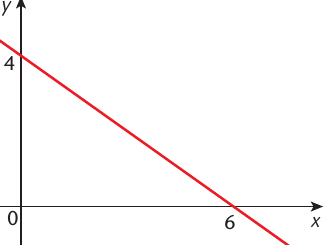
Sketch \(y=-2x+8\).
Find two convenient points for \(y=\frac{3}{2}x-3\).
Sketch the line \(2x+3y=12\), labelling both intercepts.
Begin with the basic questions, then attempt the more demanding exam-style items. Open an answer only after trying the question.
Question 7 (Foundation): Find the vertical-axis intercept of \(y=4x+5\).
Question 8 (Foundation): Find the horizontal-axis intercept of \(y=x-7\).
Question 9 (Developing): Does the graph \(y=-5x+2\) rise or fall to the right?
Question 10 (Developing): Give two plotting points for \(y=2x\).
Question 11 (Exam-style): Find both intercepts of \(3x-2y=12\).
Question 12 (Exam-style): A line has intercepts \((0,6)\) and \((3,0)\). Find its equation.
Textbook subtopic 3
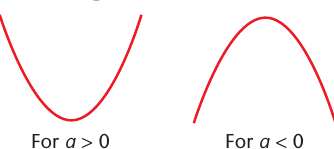
A quadratic graph \(y=ax^2+bx+c\) is a parabola. If \(a>0\) it has a minimum; if \(a<0\) it has a maximum. The graph is symmetric about a vertical line through the turning point. The \(x\)-intercepts are roots of \(ax^2+bx+c=0\).
Find the roots where possible, the \(y\)-intercept, and the turning point. For \(y=ax^2+bx+c\), the axis of symmetry is \(x=-b/(2a)\). Alternatively, write the quadratic as \(y=a(x-h)^2+k\); then the turning point is \((h,k)\).
The turning point is not always on the horizontal axis. Label both of its coordinates, including negative values.
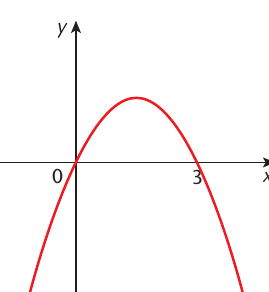
Find the intercepts of \(y=x^2-5x+6\).
Find the turning point of \(y=x^2-4x+1\).
Sketch \(y=-(x-1)^2+9\) with its intercepts and turning point.
Begin with the basic questions, then attempt the more demanding exam-style items. Open an answer only after trying the question.
Question 13 (Foundation): Does \(y=3x^2+1\) have a maximum or a minimum?
Question 14 (Foundation): Find the vertical-axis intercept of \(y=x^2+4x-2\).
Question 15 (Developing): Find the roots of \(y=x^2-9\).
Question 16 (Developing): Find the axis of symmetry of \(y=x^2-6x+5\).
Question 17 (Exam-style): Find the turning point of \(y=x^2+2x-8\).
Question 18 (Exam-style): For \(y=-x^2+4x+5\), find the maximum and both horizontal-axis intercepts.
Textbook subtopic 4
Cubic functions contain an \(x^3\) term. A positive leading coefficient gives a curve whose left end falls and whose right end rises; a negative leading coefficient reverses this. A cubic can cross the horizontal axis one or three distinct times, or touch at a repeated root.
For a useful sketch, factorise to find real roots when possible, evaluate \(y\) at \(x=0\), and make the curve pass through the intercepts in the correct order. Do not assume that every cubic has two turning points.
Repeated factors can give a touch rather than a crossing. Check whether a factor is squared.
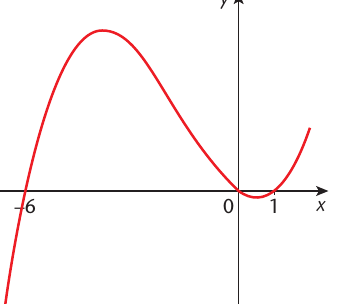
Sketch the intercept structure of \(y=x(x-2)(x+3)\).
Describe \(y=(x-2)^3+1\).
For \(y=-x(x-1)^2\), describe the behaviour at \(x=0\) and \(x=1\).
Begin with the basic questions, then attempt the more demanding exam-style items. Open an answer only after trying the question.
Question 19 (Foundation): Is \(y=x^3+2x\) cubic?
Question 20 (Foundation): Find the vertical-axis intercept of \(y=x^3-4x+7\).
Question 21 (Developing): Find the horizontal-axis intercepts of \(y=x(x+1)(x-4)\).
Question 22 (Developing): Which end of \(y=-2x^3+x\) rises?
Question 23 (Exam-style): For \(y=(x+2)^3-1\), find the central flattening point.
Question 24 (Exam-style): For \(y=x^3-4x\), find and label its real roots and state the end behaviour.
Textbook subtopic 5
A basic reciprocal graph \(y=k/x\) has two separate branches. The axes \(x=0\) and \(y=0\) are asymptotes: the curve approaches them but does not meet them. For \(k>0\) branches lie in quadrants I and III; for \(k<0\), quadrants II and IV.
A shifted reciprocal function \(y=k/(x-a)+b\) has asymptotes \(x=a\) and \(y=b\). Mark the asymptotes first, then one point in each branch. The graph is undefined where the denominator is zero.
An asymptote is generally drawn dashed. Never draw a basic reciprocal curve through its vertical asymptote.
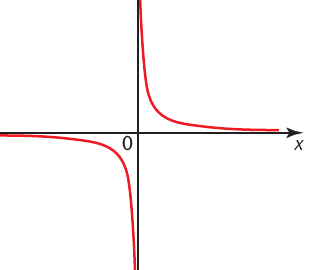
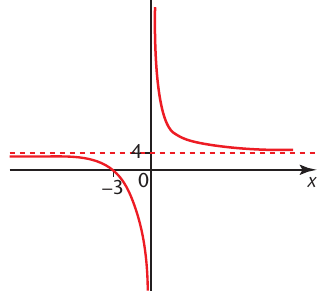
Sketch \(y=6/x\), with the asymptotes.
Find the asymptotes of \(y=3/(x-2)+1\).
Sketch \(y=-4/(x+1)+2\) using asymptotes and two points.
Begin with the basic questions, then attempt the more demanding exam-style items. Open an answer only after trying the question.
Question 25 (Foundation): Where is \(y=5/x\) undefined?
Question 26 (Foundation): Find the horizontal asymptote of \(y=7/x\).
Question 27 (Developing): Find the asymptotes of \(y=2/(x-4)+3\).
Question 28 (Developing): Find one point on \(y=-8/x\) in quadrant IV.
Question 29 (Exam-style): Find the vertical-axis intercept of \(y=4/(x+2)-1\).
Question 30 (Exam-style): For \(y=6/(x-3)-2\), give asymptotes and the horizontal-axis intercept.
Textbook subtopic 6
An exponential function such as \(y=2^x\) has the variable in the power. For a base greater than 1 it rises to the right; for a base between 0 and 1 it falls. The standard graph passes through \((0,1)\) and stays above the horizontal axis.
For \(y=a^x+k\), the horizontal asymptote is \(y=k\). Find the vertical intercept by setting \(x=0\), use a second value such as \(x=1\), and sketch the correct increasing/decreasing shape without crossing the asymptote.
A horizontal shift of an exponential must be read from its exponent, but a vertical shift changes the horizontal asymptote.
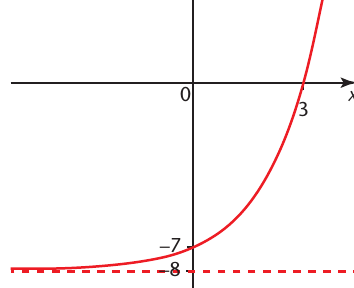
Find three points on \(y=2^x\).
Sketch \(y=2^x-3\), stating its asymptote and intercepts.
Identify the main sketch features of \(y=4(1/2)^x+1\).
Begin with the basic questions, then attempt the more demanding exam-style items. Open an answer only after trying the question.
Question 31 (Foundation): Find the vertical-axis intercept of \(y=3^x\).
Question 32 (Foundation): Is \(y=(1/3)^x\) increasing or decreasing?
Question 33 (Developing): Find the horizontal asymptote of \(y=5^x-4\).
Question 34 (Developing): For \(y=2^x+3\), calculate \(y\) at \(x=0,1\).
Question 35 (Exam-style): Find the horizontal-axis intercept of \(y=2^x-8\).
Question 36 (Exam-style): Sketch \(y=4-2^x\), labelling the asymptote and intercepts.